AI SRE and Incident Tool Pricing Compared (2026)
What Cleric, FireHydrant, incident.io, Rootly, and PagerDuty actually charge, from public pricing pages. Per-credit, per-responder, and per-user models compared.
Key Takeaways
- Incident and AI SRE tools price on three different units, which makes headline numbers hard to compare: per user, per responder, and per credit. The unit matters more than the sticker price.
- Cleric prices per credit. Tiers run "$100 / month" for "100 credits" up to "$2,000 / month" for "2,000 credits," where "Credits cost $1 on monthly plans" and an issue investigation is "10 credits."
- FireHydrant prices per responder. Its Pro plan is "$25" per "/responder/month, billed annually," with a "14-day free trial" and no card required.
- incident.io prices per user, with on-call as an add-on. Team is "$19/user/month" monthly or "$15/user/month" annual; Pro is "$25/user/month"; on-call adds "$10" to "$20" per user.
- Rootly publishes response and on-call prices but not its AI SRE price. Incident Response and On-Call Essentials are each "$20 per user/mo"; the "AI SRE" product is "Contact us."
- PagerDuty publishes incident management per user, but AIOps is a separate add-on. Professional is "$25" monthly or "$21" annual per user; AIOps has no standalone per-user price on the pricing page.
- Open-source tools have no license fee at all. The cost is the LLM tokens and infrastructure you run yourself.
AI SRE and incident management tools do not share a pricing unit: some charge per user, some per on-call responder, some per credit consumed, and open-source options charge nothing for the software itself. Comparing them means normalizing to the unit each vendor actually bills, because a per-credit and a per-user plan can look similar on the sticker and diverge sharply on the bill.
How do AI SRE and incident tools price?
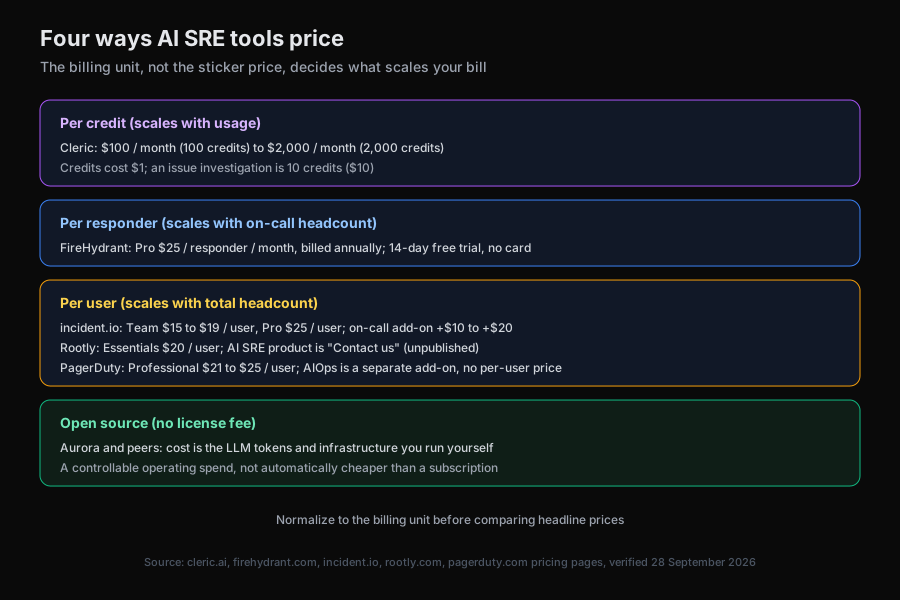
They fall into four billing models, and the model determines what scales your bill. Per-user pricing scales with headcount. Per-responder pricing scales with how many people are on call. Per-credit pricing scales with usage, such as how many incidents the agent investigates. Open-source pricing scales with the LLM tokens and compute you consume, with no license fee.
Knowing the unit is the first step in any evaluation, because it changes which lever raises your cost. A large team with few on-call engineers pays very differently under per-user versus per-responder pricing, and a team with heavy incident volume pays very differently under per-credit versus flat per-user pricing.
What do AI SRE and incident tools actually charge?
The figures below are quoted from each vendor's public pricing page, verified 28 September 2026. Where a product's price is not published, that is stated rather than estimated.
| Tool | Unit | Published price (verbatim) | Notes |
|---|---|---|---|
| Cleric | Per credit | "$100 / month" (100 credits) to "$2,000 / month" (2,000 credits) | "Credits cost $1"; issue investigation "10 credits" |
| FireHydrant | Per responder | Pro "$25" "/responder/month, billed annually" | "14-day free trial," no card |
| incident.io | Per user | Team "$19/user/month" (mo) / "$15/user/month" (annual); Pro "$25/user/month" | On-call add-on "+ $10" to "+ $20" /user/month |
| Rootly | Per user | Incident Response and On-Call Essentials each "$20 per user/mo" | "AI SRE" is "Contact us" (unpublished) |
| PagerDuty | Per user | Professional "$25" (mo) / "$21" (annual) per user | AIOps is a separate add-on, no per-user price shown |
Two entries deserve a caveat. Rootly publishes prices for its Incident Response and On-Call products but lists its "AI SRE" product only as "Contact us," so there is no public per-seat figure for the AI product specifically. PagerDuty publishes a per-user Professional price for incident management, but its AIOps capability is sold as a separate add-on with no standalone per-user price on the pricing page, so quoting the $25 figure as an "AIOps" price would be wrong.
What does Cleric's per-credit pricing mean in practice?
It means you pay for work done, not seats occupied. Cleric's pricing page sets the unit at "Credits cost $1 on monthly plans" and prices an "Issue investigation" at "10 credits," or $10. Its tiers bundle credits: Starter "$100 / month" for "100 credits / month," Team "$600 / month" for "600 credits / month," Pro "$2,000 / month" for "2,000 credits / month," and Enterprise "Custom." Unused credits "roll over for one month, up to twice your monthly allocation," and a trial gives "500 evaluation credits · No time limit."
This model is predictable for low incident volume and scales with load rather than headcount. At $10 per investigated issue, a team can map its expected incident volume directly to a bill, which is harder to do under per-user pricing where the cost is fixed regardless of how much the tool is used.
What about FireHydrant, incident.io, Rootly, and PagerDuty?
Each publishes its core pricing, but on different units. FireHydrant prices its Pro plan at "$25" per "/responder/month, billed annually" and offers to "Start with a 14-day free trial of our Pro plan. No credit card required," noting that its Signals alerting "is charged based on the number of alerts you send." incident.io prices per user: Team at "$19/user/month" monthly or "$15/user/month" annual, Pro at "$25/user/month," with an on-call add-on of "+ $10/user/month" on Team and "+ $20/user/month" on Pro, and a standalone on-call product at "$20/user/month." Rootly lists Incident Response Essentials and On-Call Essentials each at "$20 per user/mo." PagerDuty lists its Professional incident-management tier at "$25" monthly or "$21" per user per month annual.
Where does open source fit on cost?
Open-source AI SRE tools remove the license line entirely; the cost is what you spend on model tokens and the infrastructure to run them. Aurora is open source, so there is no per-user, per-responder, or per-credit fee for the software. It runs a single investigation agent by default with an opt-in multi-agent orchestrator, tracks per-investigation cost, and routes on a cost model (RCA_OPTIMIZE_COSTS defaults on) with prompt caching, so the token spend that is your actual cost is measured rather than hidden.
That does not make open source automatically cheaper; a hosted per-credit or per-user plan can be cheaper than the engineering time to run a tool well. It makes the cost structure different: you trade a predictable subscription for token and operating costs you control directly. For choosing on more than price, see how to evaluate an AI SRE platform, the per-investigation view in the cost of AI incident investigation, and the field in top AI SRE tools 2026.
The summary
Incident and AI SRE pricing does not compare cleanly because the unit differs: Cleric bills per credit ($100 to $2,000 a month, $10 per investigated issue), FireHydrant per responder ($25/responder/month annual), incident.io and Rootly and PagerDuty per user (roughly $15 to $25), and open source not at all beyond tokens and compute. Rootly does not publish its AI SRE price and PagerDuty does not publish a per-user AIOps price, so both are "contact sales" for the AI capability. Normalize to the billing unit before comparing.
Try Aurora
- Start free: aurora-ai.net (hosted, no infrastructure to run)
- GitHub: github.com/Arvo-AI/aurora
- Book a demo: cal.com/arvo-ai/demo
- See it on an incident: Aurora root cause analysis
Sourcing note. All prices are quoted from the vendors' public pricing pages, verified 28 September 2026: cleric.ai/pricing, firehydrant.com/pricing, incident.io/pricing, rootly.com/pricing, and pagerduty.com/pricing. Where a product's price is not published (Rootly's AI SRE, PagerDuty's per-user AIOps), that is stated rather than estimated. Pricing changes often; re-check each page before relying on a figure. Aurora's cost model is described from its open-source repository.