Is AI Reducing MTTR for SRE Teams? (2026 Data)
Dynatrace's State of SRE 2026 survey finds half of SREs use AI for automated incident response, yet AI is falling short on MTTR and cost. What the numbers say.
Key Takeaways
- A 2026 survey of 919 SRE leaders finds AI adoption in incident response is now widespread, but the survey reports AI is underdelivering on the two outcomes teams bought it for: lower MTTR and lower cost. The findings are from Dynatrace's State of SRE and Platform Engineering 2026, which it commissioned.
- Half of SREs now use AI for incident response. The report states "Half of SREs now use AI-powered capabilities for automated incident response."
- Yet AI is reported as falling short on the headline outcomes. The report says AI is "delivering less impact than expected in lowering costs and reducing mean time to resolution (MTTR)."
- AI-model monitoring has become the top SRE use case. The report finds "67% of SREs now naming AI model monitoring their top use case," reflecting that SREs increasingly operate AI systems, not just use AI tools.
- SRE practice is mature on fundamentals. "89% use service-level objectives (SLOs) across at least some teams or systems," and "92% of organizations report executive leadership support for SRE initiatives."
- Read the survey as commissioned and fielded earlier than published. It was "conducted and analyzed by Qualtrics partner Y2 on behalf of Dynatrace," with fieldwork from October 2025 to January 2026 and publication in August 2026.
Dynatrace's State of SRE 2026, a survey of 919 SRE leaders, reports that AI incident-response adoption reached half of SREs while delivering less impact than expected on cost and mean time to resolution. The gap between adoption and payoff is the survey's central tension for anyone deciding whether an AI SRE tool actually moves the number that matters.
What does the 2026 data say about AI and MTTR?
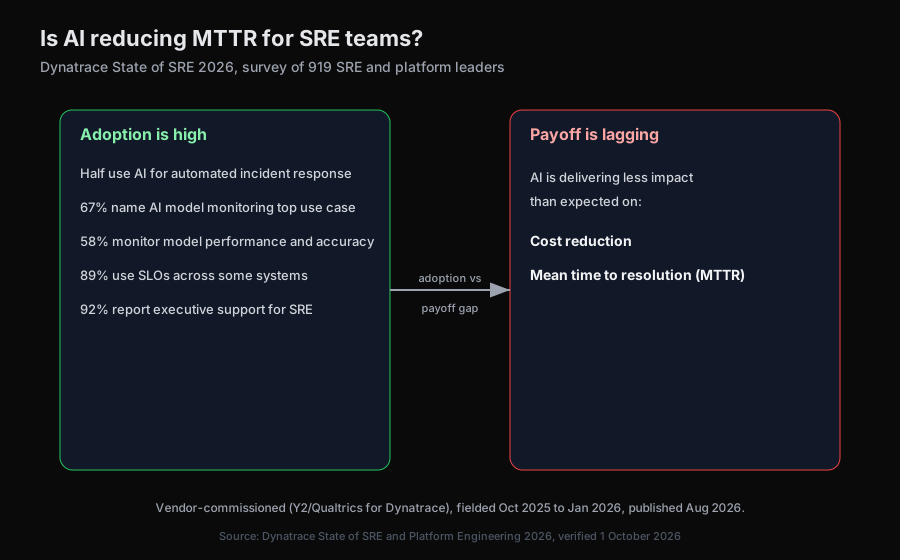
It says adoption is high and the headline payoff is lagging. The Dynatrace report states that "Half of SREs now use AI-powered capabilities for automated incident response," which puts AI squarely inside the incident workflow for a large share of teams. In the same release, Dynatrace reports that AI is "falling short on cost reduction and MTTR," "delivering less impact than expected in lowering costs and reducing mean time to resolution (MTTR)." Adoption has outpaced measurable results on the two outcomes teams most often justify the spend with.
That gap is the useful signal for a buyer. It does not say AI has no value in incident response; it says the specific promise of a lower MTTR has, in this survey of practitioners, not landed as expected yet. Treat a vendor's MTTR-reduction claim as a hypothesis to test against your own incidents, not a settled result.
What are SREs actually using AI for?
Increasingly, to operate AI systems themselves. The report finds "67% of SREs now naming AI model monitoring their top use case," and that monitoring "for model performance and accuracy" is "already the most common AI-powered capability among SREs (58%)." The job is shifting: SREs are not only adopting AI tools, they are increasingly on the hook for the reliability of the AI their companies ship. Automated incident response, at half of SREs, is a major use case but not the top one.
That reframing matters for tool selection. An AI SRE is being evaluated by people who now also run AI in production and understand its failure modes firsthand, which raises the bar on transparency and on evidence that a tool's output can be trusted.
How mature is SRE practice overall?
Mature on fundamentals, by this survey. The report finds "89% use service-level objectives (SLOs) across at least some teams or systems" and "92% of organizations report executive leadership support for SRE initiatives." SLOs are near-universal and executive backing is broad, which means AI tooling is being adopted into established practice rather than filling a vacuum. The report also notes that "73% of SRE and platform engineering teams now collaborate and share responsibilities," a sign of converging platform and reliability functions.
| Finding (Dynatrace State of SRE 2026) | Figure |
|---|---|
| SREs using AI for automated incident response | "Half" |
| SREs naming AI model monitoring their top use case | "67%" |
| Model performance/accuracy monitoring as AI capability | "58%" |
| Teams using SLOs across at least some systems | "89%" |
| Organizations with executive support for SRE | "92%" |
| AI impact on cost and MTTR | "delivering less impact than expected" |
Why would AI adoption outrun MTTR gains?
The survey reports the gap but not its mechanism, so what follows is interpretation rather than a survey finding. One plausible reason is that MTTR is dominated by stages AI touches least: coordination, change approval, and the human decision to act, not just the investigation an AI accelerates. Another is measurement itself. Without a consistent baseline, a team cannot attribute an MTTR change to a tool, which is the same reason an AI SRE vendor cannot credibly publish a single accuracy or MTTR-reduction figure that transfers across environments.
This is why evaluation discipline matters more than a headline number. Measuring whether AI reduces your MTTR means instrumenting your own incident timeline and comparing like with like, a point developed in measuring AI SRE without ground truth and in how to evaluate an AI SRE platform.
What should a buyer take from this?
Buy for the workflow you can verify, not the number in the pitch. AI in incident response is now mainstream, but this survey of 919 practitioners says the MTTR and cost payoff is still trailing adoption. A tool that shows its evidence, states what it ruled out, and lands actions through human approval is one you can actually measure; a tool that only reports a confident conclusion is one you cannot. Aurora is built around that measurability: it tracks per-investigation cost, produces a per-incident execution timeline, requires its sub-agent findings to include a "What I ruled out" section and a self-assessed strength, and lands any fix as a pull request a human merges. It publishes no accuracy or MTTR figure, because no benchmark exists that would make such a number defensible. For the wider picture, see AI SRE accuracy benchmarks and rising SRE toil in 2026.
The summary
Dynatrace's State of SRE and Platform Engineering 2026, surveying 919 SRE leaders, finds half of SREs now use AI for automated incident response and 67% name AI model monitoring their top use case, against a mature backdrop of 89% SLO use and 92% executive support. But the same survey reports AI is delivering less impact than expected on cost and MTTR. The lesson for buyers is to measure AI's effect on their own incidents rather than trust a vendor's MTTR claim, and to prefer tools whose output can be verified. The survey is Dynatrace-commissioned, fielded October 2025 to January 2026.
Try Aurora
- Start free: aurora-ai.net (hosted, no infrastructure to run)
- GitHub: github.com/Arvo-AI/aurora
- Book a demo: cal.com/arvo-ai/demo
- See it on an incident: Aurora root cause analysis
Sourcing note. All survey figures and quoted wording are from Dynatrace's State of SRE and Platform Engineering 2026 press release, verified 1 October 2026: half of SREs using AI for automated incident response, 67% naming AI model monitoring their top use case, 58% monitoring model performance and accuracy, 89% using SLOs, 92% with executive support, and AI "delivering less impact than expected in lowering costs and reducing mean time to resolution (MTTR)." The survey is vendor-commissioned, "conducted and analyzed by Qualtrics partner Y2 on behalf of Dynatrace," with N=919, fieldwork October 2025 to January 2026, and publication in August 2026. The reasoning about why adoption may outrun MTTR gains is interpretation, not a survey finding. Aurora's capabilities are described from its open-source repository; no Aurora accuracy or MTTR figure is claimed because no such benchmark exists.