PagerDuty vs Jira Service Management (2026)
PagerDuty is an operations and on-call platform. Jira Service Management is an ITSM service desk with on-call built in. How the two compare for incident response, with pricing.
Key Takeaways
- PagerDuty and Jira Service Management overlap on incident response and on-call but start from different jobs: PagerDuty is an operations platform built around alerting and on-call, while Jira Service Management is an IT service desk that added on-call and incident management. This decision now faces every team migrating off Opsgenie.
- PagerDuty centers on on-call and alerting. Its site describes "On-call scheduling and escalations" that "safeguard the business with 24x7 coverage" and notifications "via custom-defined methods such as SMS messages, mobile app push notifications, phone calls, or emails."
- Jira Service Management bundles incident management into a service desk. Atlassian describes "Incident management for high-velocity teams" that can "Aggregate incoming alerts and signals from all your monitoring, service desk and logging applications" and route them "using powerful routing rules."
- PagerDuty's AIOps and SRE Agent are separate from the base plan. Its AIOps page markets event correlation and noise reduction as an add-on, and its SRE Agent "Detects, triages, diagnoses incidents and performs approved remediation."
- Pricing uses different units. PagerDuty's incident-management Professional tier is "$25" monthly or "$21" per user per month annual; Jira Service Management prices per agent and is tightly coupled to the Atlassian suite.
- This is now an Opsgenie migration decision. Atlassian is retiring Opsgenie, so many teams are choosing between consolidating into Jira Service Management or moving to PagerDuty.
PagerDuty is an operations platform built around on-call, alerting, and incident response, while Jira Service Management is an IT service desk that added on-call and incident management to a ticketing and ITSM core. They are compared most often now because Atlassian is retiring Opsgenie, which forces its users to pick a replacement, and the two leading paths are consolidating into Jira Service Management or adopting PagerDuty.
Why are teams comparing PagerDuty and Jira Service Management now?
Because Opsgenie is being discontinued and its users have to move. Atlassian's announcement set an end of sale of "June 4th, 2025," after which "you'll no longer be able to purchase or sign up for Opsgenie," and an end of support of "April 5th, 2027," when "access to Opsgenie will be shut off, and the product will no longer accessible. Any unmigrated data in Opsgenie will also be deleted." Atlassian is steering Opsgenie customers into Jira Service Management with "a personalized in-product migration tool," which puts the PagerDuty-versus-JSM choice in front of every Opsgenie team. The migration mechanics are covered in depth in the Opsgenie 2026 guide; this comparison is about the two replacements themselves.
What does PagerDuty do?
PagerDuty is an operations platform whose core is on-call management and incident response. Its on-call page describes scheduling and escalations as "key to equitably distributing workloads while safeguarding the business with 24x7 coverage," lets teams "Set up on-call schedules to support any kind of standard or custom rotation (weekly, weekend, follow-the-sun, etc.)," and escalates automatically: "If an alert is not acknowledged, it is passed to the next responder." It notifies responders "via custom-defined methods such as SMS messages, mobile app push notifications, phone calls, or emails."
Its incident-management page frames the product as "End-to-end orchestration for rapid issue resolution" with "Guided remediation throughout the entire incident lifecycle." Advanced correlation is a separate AIOps capability that "leverages AI algorithms to automatically correlate and deduplicate large volumes of incoming events," and PagerDuty also markets an SRE Agent that "Detects, triages, diagnoses incidents and performs approved remediation." PagerDuty states it has "750+ platform integrations."
What does Jira Service Management do?
Jira Service Management is an IT service management (ITSM) desk from Atlassian that has incident management and on-call built on top of its ticketing core. Its incident-management page describes "Incident management for high-velocity teams" that lets a team "respond, resolve, and learn from incidents." It can "Aggregate incoming alerts and signals from all your monitoring, service desk and logging applications," "Automatically reduce noise and surface the most important issues to the right team," and "Notify the right people using powerful routing rules and multiple communication channels including SMS, email, push notifications, chat and voice calls." It also supports "incident swarming and on-call capabilities" and lets teams "attach runbooks to alerts."
The on-call and alerting capabilities inside Jira Service Management are the direct successor to Opsgenie's: Atlassian documents that "When you migrate from Opsgenie to Jira Service Management or Compass, Operations will function across both products," and that "All alerts, on-call schedules, integrations, and policies will sync across both products." The distinguishing feature is the deep tie to the rest of Atlassian: Jira issues, Confluence, and the service desk sit in one suite.
How do PagerDuty and Jira Service Management compare?
The split is operations platform versus service desk. One is built outward from on-call; the other is built outward from ticketing and ITSM.
| Dimension | PagerDuty | Jira Service Management |
|---|---|---|
| Starting point | Operations and on-call platform | ITSM service desk with on-call added |
| On-call and escalation | Core; custom rotations, auto-escalation on no-ack | Built in; "incident swarming and on-call capabilities" |
| Alerting channels | "SMS messages, mobile app push notifications, phone calls, or emails" | "SMS, email, push notifications, chat and voice calls" |
| Alert correlation / AIOps | Separate AIOps add-on, "correlate and deduplicate" events | "Automatically reduce noise and surface the most important issues" |
| AI agent | SRE Agent, "performs approved remediation" | Within the Atlassian AI / Rovo layer |
| Suite integration | "750+ platform integrations" | Native Jira, Confluence, and service-desk suite |
| Pricing unit | Per user ("$25" monthly, "$21" annual, Professional) | Per agent, coupled to the Atlassian suite |
The trade is focus versus consolidation. PagerDuty is the deeper operations and on-call tool, with mature escalation, a large integration catalog, and AIOps and an SRE Agent available as added capabilities. Jira Service Management is the better fit for a team that wants on-call and incident management inside the same suite as its tickets, service desk, and documentation, which is also the lowest-friction path for an Opsgenie team already in the Atlassian ecosystem.
How do PagerDuty and Jira Service Management price?
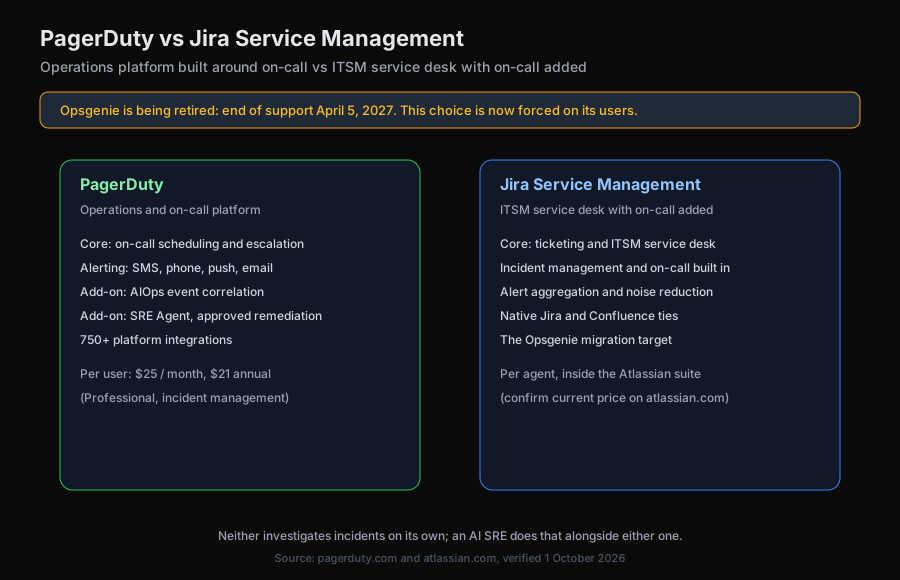
They bill on different units, so compare the unit, not the sticker. PagerDuty's pricing page lists its incident-management Professional tier at "$25" per user per month monthly, or "$21" per user per month annual, with a Free tier for "5 users" that includes "1 on-call schedule, 1 escalation policy." Its AIOps, Status Pages, and other capabilities are add-ons sold separately, so the Professional price is not an all-in figure. Jira Service Management prices per agent and is tightly coupled to the Atlassian suite; because its public pricing is rendered dynamically, confirm the current per-agent figures on Atlassian's pricing page before relying on them. The practical point is that PagerDuty bills per responder-style user with AIOps on top, while Jira Service Management bills per agent and derives much of its value from being inside the suite you already run.
Which should a team choose?
It depends on where the team already lives and how deep its on-call needs run. A team that wants the strongest standalone on-call and incident-response platform, with mature escalation, a large integration catalog, and the option to add AIOps correlation and an SRE Agent, fits PagerDuty. A team already standardized on Jira and Confluence, especially an Opsgenie team taking the in-product migration path, gets the least friction from consolidating into Jira Service Management and keeping on-call inside the suite.
Either way, both are alerting and workflow tools rather than investigators: they route the page and track the incident, but they do not find the root cause for you. An AI SRE sits alongside either one to do the investigation. Aurora is open source, runs a single investigation agent by default with an opt-in multi-agent orchestrator, and lands any fix as a pull request a human merges. For related reading, see the Opsgenie 2026 guide, the PagerDuty alternative for root cause analysis, open-source incident management, and Aurora root cause analysis.
The summary
PagerDuty is an operations platform built around on-call and alerting, with AIOps and an SRE Agent as add-ons and per-user pricing (Professional "$25" monthly, "$21" annual). Jira Service Management is an ITSM service desk with on-call and incident management built in, priced per agent and most valuable inside the Atlassian suite. With Opsgenie retiring by April 5, 2027, the choice comes down to whether a team wants the deeper standalone operations tool or the lowest-friction consolidation into the suite it already runs. Neither investigates incidents; an AI SRE does that alongside either one.
Try Aurora
- Start free: aurora-ai.net (hosted, no infrastructure to run)
- GitHub: github.com/Arvo-AI/aurora
- Book a demo: cal.com/arvo-ai/demo
- See it on an incident: Aurora root cause analysis
Sourcing note. PagerDuty's on-call, incident-management, AIOps, SRE Agent, integration-count, and pricing wording are quoted from pagerduty.com pages, verified 1 October 2026. Jira Service Management's incident-management and alerting wording is quoted from atlassian.com, and the Opsgenie end-of-sale and end-of-support dates and migration wording are quoted from Atlassian's official announcement and support docs, verified the same day. Jira Service Management per-agent pricing is rendered dynamically and was not fetchable at verification time, so no figure is quoted; confirm it on Atlassian's pricing page. Vendor marketing figures such as PagerDuty's integration count are the vendor's own claims. Pricing changes; re-check each page before relying on a figure.