DORA and Frontier AI: What the 2026 ESA Statement Says
On 31 July 2026 the EU's three financial regulators tied frontier AI risk to DORA oversight. What the statement requires, and what it does not.

Key Takeaways
- The EU's three financial supervisors issued a joint statement on frontier AI on 31 July 2026. The EBA, EIOPA and ESMA statement (reference JC 2026 25) calls "for a cross-sectoral, risk-based and consistent supervisory approach to mitigate the ICT risks stemming from frontier AI models."
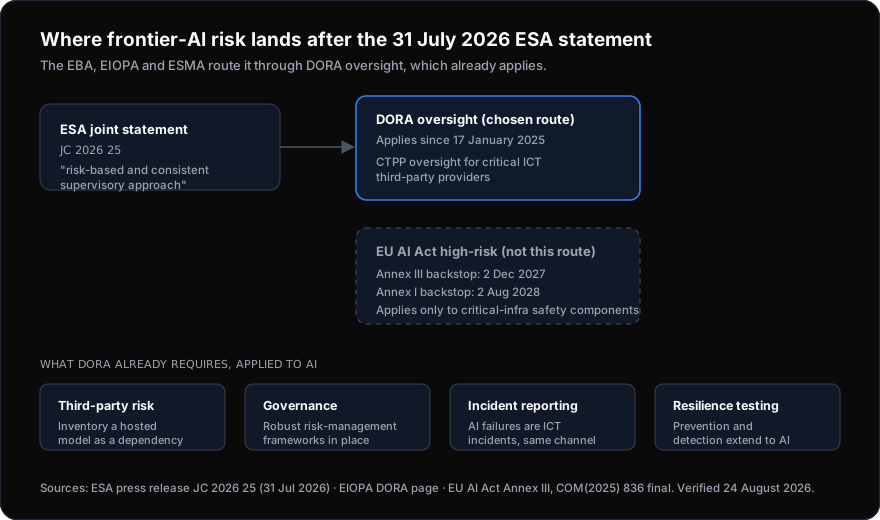
- It routes through DORA, not the AI Act. The statement points to "updates on ongoing and planned DORA oversight activities for critical ICT third-party providers (CTPPs) to address this risk," placing frontier-AI risk inside the Digital Operational Resilience Act's existing machinery rather than new law.
- The ask is governance, not a ban. Regulators say "financial entities should have robust governance and risk management frameworks in place," with "emphasis is placed on the prevention, detection and management of these risks."
- DORA has applied since 17 January 2025. Per EIOPA, the regulation "entered into application on 17 Jan 2025," so its incident-reporting and third-party obligations are already live for financial entities.
- The statement is a supervisory-dialogue tool, not a binding rule. Regulators "encourage both financial entities and competent authorities to use the statement as a basis for supervisory dialogue," which means it shapes examinations rather than creating new penalties.
- Most AI incident tooling is not "high-risk" under the AI Act. Under Annex III, operational AI is high-risk only when it is a safety component in the management of critical digital infrastructure, a narrow category that ordinary investigation assistants do not meet.
Frontier AI in EU financial services is now a digital-operational-resilience question: on 31 July 2026 the EBA, EIOPA and ESMA jointly asked supervisors to treat the ICT risks from frontier AI models under DORA's existing oversight framework rather than wait for new legislation. That reframing matters because DORA already applies, and its obligations attach to how financial entities run and depend on technology, including the AI systems now entering incident response.
This post separates what the joint statement actually says from the compliance claims that tend to get built on top of it.
What did the EBA, EIOPA and ESMA actually say?
The three European Supervisory Authorities (ESAs) published a joint statement, referenced JC 2026 25, dated 31 July 2026. The headline is precise about scope: the regulators "call for enhanced governance and consistent supervision to mitigate ICT risks from frontier AI models in the EU financial sector."
Three phrases carry the substance. First, the approach: "a cross-sectoral, risk-based and consistent supervisory approach to mitigate the ICT risks stemming from frontier AI models." Second, the objective: "measures to help financial entities strengthen their operational resilience against cyber risks linked to frontier AI models," where "emphasis is placed on the prevention, detection and management of these risks." Third, the expectation on firms: "financial entities should have robust governance and risk management frameworks in place."
The statement's own status is the part most easily overstated. It is not a regulation and not a technical standard. The ESAs "encourage both financial entities and competent authorities to use the statement as a basis for supervisory dialogue." In practice that means it will inform how examiners ask questions, not that a new fine schedule exists.
Why is this a DORA matter rather than an AI Act matter?
Because the statement explicitly connects frontier-AI risk to DORA's oversight, not to the AI Act. It references "updates on ongoing and planned DORA oversight activities for critical ICT third-party providers (CTPPs) to address this risk."
That choice is deliberate. The Digital Operational Resilience Act "entered into application on 17 Jan 2025" and already governs how financial entities manage ICT risk, report major ICT-related incidents, test resilience, and manage third-party dependencies. It also "establishes an EU-wide oversight framework for critical ICT third-party providers (CTPPs)." A frontier model accessed as a service, or the vendor that hosts it, can fall inside that third-party perimeter. Routing the risk through DORA means no new statute is required to start asking about it.
The table below maps the regulation's existing pillars to the frontier-AI concern the ESAs raised.
| DORA pillar | What it already requires | Frontier-AI relevance |
|---|---|---|
| ICT risk management | Governance and risk frameworks for ICT | The statement's core ask: "robust governance and risk management frameworks" for AI |
| ICT third-party risk | Monitoring providers, contractual provisions | A hosted frontier model is a third-party dependency to inventory and assess |
| CTPP oversight | EU-wide oversight of critical providers | The named mechanism for "planned DORA oversight activities" on AI risk |
| Incident reporting | Report major ICT-related incidents | AI-involved failures are ICT incidents, not a separate category |
| Resilience testing | Basic and advanced testing | Prevention and detection extend to AI-linked failure modes |
Does this make AI incident tooling "high-risk" under the EU AI Act?
Generally no, and conflating the two regimes is the most common error in coverage of this topic. The AI Act and DORA are separate instruments with separate triggers.
Under the AI Act's Annex III, operational AI is classified high-risk only when it functions as "a safety component in the management and operation of critical digital infrastructure." An assistant that reads logs, correlates a deploy with an onset time, and drafts a root-cause hypothesis for a human is not managing critical infrastructure. The high-risk label attaches to a narrow set of control-plane roles, not to investigation support.
Timing reinforces the separation. The AI Act's high-risk application dates were moved by the Digital Omnibus amendment (COM(2025) 836 final), which sets backstop dates of "2 December 2027 as regards AI systems classified as high-risk pursuant to Article 6(2) and Annex III" and "2 August 2028 as regards AI systems classified as high-risk pursuant to Article 6(1) and Annex I." The DORA obligations discussed here, by contrast, are already in force.
What should a financial entity running AI in operations do now?
The statement asks for governance, prevention, detection and management. Translated into operational terms, that is mostly work DORA already expects, applied to the AI systems now in the incident path.
- Inventory the AI dependency as a third party. If an investigation tool calls a hosted frontier model, that model provider is an ICT third party under DORA. Record it, assess concentration risk, and check the contractual provisions DORA requires.
- Keep a human in the decision loop for anything that changes production. Prevention and detection are easier to evidence when an agent proposes and a person approves. Who is accountable when an agent acts is its own question, covered in AI agent accountability and audit evidence.
- Capture audit evidence at the point of action. Supervisory dialogue rewards records that show what the system did, when, and under whose approval. Guardrail and approval events are the material examiners can actually read, discussed in AI agent guardrails in production.
- Treat AI-involved failures as ICT incidents. They report through the same DORA channel as any other major ICT-related incident, not a separate AI process.
- Reduce third-party surface where you can. A self-hosted, open-source tool that runs in your own environment adds fewer external dependencies to the CTPP calculation than a closed SaaS that becomes a critical provider in its own right. This is a structural point, not a compliance guarantee.
How does an open-source, self-hosted investigation tool fit DORA's third-party concern?
The relevant property is where the software and its data live. DORA's third-party pillar exists because outsourced ICT concentrates risk in providers a financial entity does not control. A tool that a bank self-hosts, under an Apache 2.0 license, does not become a new critical ICT third-party provider in the way a closed hosted platform can.
Aurora is built around human-gated action rather than autonomy: its structural chokepoint denies mutating writes when no interactive human is present, and its guardrail events are recorded with sha256 fingerprints that never log raw command content. Those are governance and evidence properties, not a claim of DORA compliance. Compliance is a determination a financial entity and its supervisor make about the whole control environment, not a feature a tool ships. The honest framing is that self-hosting and human-gating make the governance story easier to tell, and the open-source repository lets a risk team read the controls rather than take them on trust.
For the incident-management context these controls sit inside, see open source incident management and the root cause analysis guide for SREs.
Try it in your own environment
Aurora is Apache 2.0 and self-hostable, so a financial-sector platform team can evaluate it inside its own perimeter rather than sending incident data to an external service. One LLM API key is the only hard requirement; cloud connectors are optional, and local models via Ollama support fully self-contained deployments.
git clone https://github.com/arvo-ai/aurora.git && cd aurora

make init                # generates secrets, copies .env.example to .env
nano .env                # add OPENROUTER_API_KEY (or OPENAI_API_KEY / ANTHROPIC_API_KEY)
make prod-prebuilt       # pulls prebuilt images from GHCR and starts
Open http://localhost:3000. The first user to register becomes admin.
- Start free: aurora-ai.net (hosted, no infrastructure to run)
- GitHub: github.com/Arvo-AI/aurora
- Related guides: AI Agent Accountability and Audit Evidence · AI Agent Guardrails in Production · Open Source Incident Management · Root Cause Analysis for SREs
Sourcing note. The joint statement, its reference number (JC 2026 25), and every quoted phrase come from the ESAs' own press release dated 31 July 2026. DORA's application date and oversight-framework description come from EIOPA's DORA page. AI Act high-risk classification and the moved application dates come from the consolidated regulation on EUR-Lex and the Digital Omnibus proposal COM(2025) 836 final. This post does not assert that any tool makes an entity DORA-compliant, because that is a supervisory determination rather than a product feature. Verified 24 August 2026.