Cleric vs Resolve.ai: AI SRE Compared (2026)
Cleric is a per-credit AI SRE that opens fix PRs for approval. Resolve.ai is an autonomous on-call AI SRE funded past $190M. How the two differ, with pricing.
Key Takeaways
- Cleric and Resolve.ai are both commercial AI SREs that go on call, but they diverge on pricing transparency, how much authority the agent holds, and company scale. Cleric publishes per-credit pricing; Resolve.ai publishes none and sells through sales.
- Cleric meters usage per credit. Tiers run "$100 / month" for "100 credits" up to "$2,000 / month" for "2,000 credits," where "Credits cost $1 on monthly plans" and an issue investigation is "10 credits."
- Cleric keeps write access opt-in. Its site says "Read-only by default" and "Read access by default, write access when you're ready," and it "opens PR" for a fix once approved.
- Resolve.ai markets autonomous resolution. Its site says the agent "Goes on-call on your behalf and autonomously resolves incidents" and "Holds the pager. Triages and mitigates alerts, escalating only when you are needed."
- Resolve.ai is the larger-funded company. It announced a "$40M series A extension" on "April 16, 2026," bringing "more than $190M in funding" at a "$1.5B" valuation, with founders described as "co-creators of OpenTelemetry."
- The real choice is operating model, not a feature checklist. Metered and staged-authority versus autonomous and enterprise-priced, and how much you want the agent to do without a human in the loop.
Cleric and Resolve.ai are both commercial AI SREs that go on call and investigate incidents, but Cleric meters usage per credit with opt-in write access, while Resolve.ai sells an autonomous agent and publishes no price. The two are compared because both automate the first pass of an incident and both offer to hold the pager, yet they differ on cost model, how much the agent is allowed to do on its own, and company scale.
What is Cleric?
Cleric is a commercial, hosted AI SRE that takes alerts, investigates them, and can propose fixes through review. Its site positions it around prevention and on-call relief: "Agents that check every production change, then fix regressions before customers notice," and "Give the pager to Cleric." The access model is staged: "Read-only by default. Every action logged, every investigation auditable," and "Read access by default, write access when you're ready." When it acts, it does so through review, with the site showing steps like "Cleric opens PR #484 for your approval" and describing how it "brings you the cause, the evidence, and a fix PR to review." Cleric is operated by "Agentik, Inc. dba Cleric" and states it is "SOC 2 Type II compliant, with regular manual penetration testing." It was named a "Gartner® Cool Vendor in AI for SRE and Observability."
What is Resolve.ai?
Resolve.ai is a commercial AI SRE built to go on call and resolve incidents with less human involvement. Its site describes the agent as one that "Goes on-call on your behalf and autonomously resolves incidents," that "Holds the pager. Triages and mitigates alerts, escalating only when you are needed," and that "Identifies the root cause quickly, mitigates and restores service in minutes, not hours." It also "Fixes recurring issues by finding root problems and giving the production context to coding agents" and lets teams "Build custom SRE agents for any automation you need, fully managed for you." The company is well funded: its news page states it was "Founded October, 2024," announced a "$40M series A extension" on "April 16, 2026" for "more than $190M in funding" at a "$1.5B" valuation, with investors including DST Global, Lightspeed, Greylock, and Unusual Ventures, and a team that "includes Co-creators of OpenTelemetry." Resolve.ai does not publish pricing; it is sold through its sales team.
Note that the outcome figures on Resolve.ai's site, such as cutting downtime or on-call load by a stated percentage, are the vendor's own marketing numbers rather than independently verified results, so they are not restated as fact here.
How do Cleric and Resolve.ai compare?
The clearest axis is operating model: how the agent is priced and how much authority it holds by default.
| Dimension | Cleric | Resolve.ai |
|---|---|---|
| Model | Commercial, hosted (Agentik, Inc. dba Cleric) | Commercial, hosted |
| Pricing | Public, per credit: "$100 / month" to "$2,000 / month" plus Enterprise | Not published; sales-led |
| Authority posture | "Read-only by default," write access opt-in | "autonomously resolves incidents," escalates "only when you are needed" |
| Acts on systems | Investigates, then "opens PR" for approval | "Triages and mitigates alerts," hands fixes to coding agents |
| On-call | "Give the pager to Cleric" | "Holds the pager" |
| Compliance / scale | "SOC 2 Type II compliant" | "$1.5B" valuation, "more than $190M in funding" |
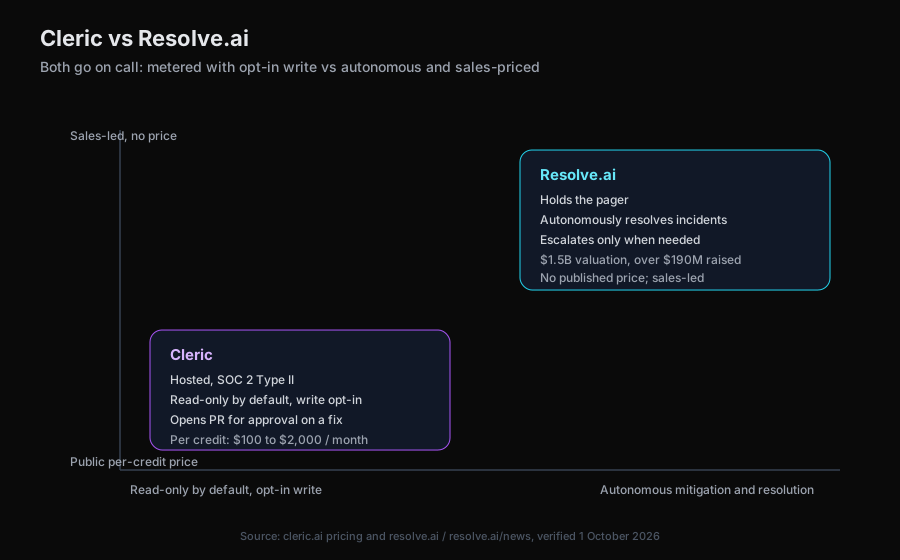
The table makes the trade explicit. Cleric gives a metered agent whose default is read-only and whose fixes land as a pull request a human approves, so cost and authority are both easy to bound. Resolve.ai markets a more autonomous agent that triages and mitigates on its own and escalates only when needed, backed by a much larger funding base, with pricing you get from a sales conversation rather than a public page.
How much does each cost?
Only one of the two publishes a price. Cleric's pricing page lists Starter at "$100 / month" for "100 credits / month," Team at "$600 / month" for "600 credits / month," Pro at "$2,000 / month" for "2,000 credits / month," and Enterprise at "Custom." The unit economics are stated plainly: "Credits cost $1 on monthly plans," an "Issue investigation" is "10 credits" (so "$10"), and checking "one production change for regressions" is also "10 credits." Unused credits "roll over for one month, up to twice your monthly allocation," and a trial gives "500 evaluation credits · No time limit."
Resolve.ai publishes no pricing page, so its cost is a sales-led quote rather than a figure you can map to incident volume in advance. For buyers, that is itself a planning difference: Cleric lets a team estimate a monthly bill from its expected incident count, while Resolve.ai requires a conversation to size.
Which should an SRE team choose?
It depends on how much the agent should do without a human and how predictable the bill needs to be. A team that wants a metered agent, a read-only default, and fixes that always arrive as a pull request to approve fits Cleric, and can estimate cost from incident volume up front. A team that wants an agent to hold the pager and mitigate incidents more autonomously, and is prepared to run an enterprise sales process to price it, fits Resolve.ai.
A third option keeps the control of open source while still letting the agent propose a fix. Aurora is built that way: a single investigation agent by default with an opt-in multi-agent orchestrator, powerful tools behind an explicit allowlist, sandboxed Kubernetes execution when enabled, and a structural chokepoint that blocks mutating writes when no human is present, so remediation only ever lands as a pull request a human merges. For how to weigh these, see how to evaluate an AI SRE platform, the open-source Resolve.ai alternative, HolmesGPT vs Cleric, and Aurora root cause analysis.
The summary
Cleric and Resolve.ai both automate incident investigation and both offer to hold the pager, but they sit at different points. Cleric is metered per credit ($100 to $2,000 a month, $10 per investigated issue), read-only by default with opt-in write, and lands fixes as an approved pull request. Resolve.ai markets a more autonomous agent that mitigates incidents on its own, is backed by more than $190M in funding at a $1.5B valuation, and publishes no price. Decide on operating model and authority, not a feature scorecard.
Try Aurora
- Start free: aurora-ai.net (hosted, no infrastructure to run)
- GitHub: github.com/Arvo-AI/aurora
- Book a demo: cal.com/arvo-ai/demo
- See it on an incident: Aurora root cause analysis
Sourcing note. Cleric's positioning, read-only and write-access wording, PR-approval flow, SOC 2 Type II statement, Gartner Cool Vendor mention, and all pricing (tiers, credits, per-credit cost, issue-investigation cost, rollover, trial) are quoted from cleric.ai and its pricing page, verified 1 October 2026. Resolve.ai's product wording, founding date, funding total, valuation, and OpenTelemetry-founder description are quoted from resolve.ai and resolve.ai/news, verified the same day. Resolve.ai's own outcome percentages are vendor marketing and are not restated as fact. Pricing and funding change; re-check each page before relying on a figure. Aurora's controls are described from its open-source repository.