EU AI Act for AI Agents in Production (2026)
The AI Omnibus moved the high-risk deadlines. What actually applies to an AI SRE agent now, whether it is in scope, and the exact dates that changed.

Key Takeaways
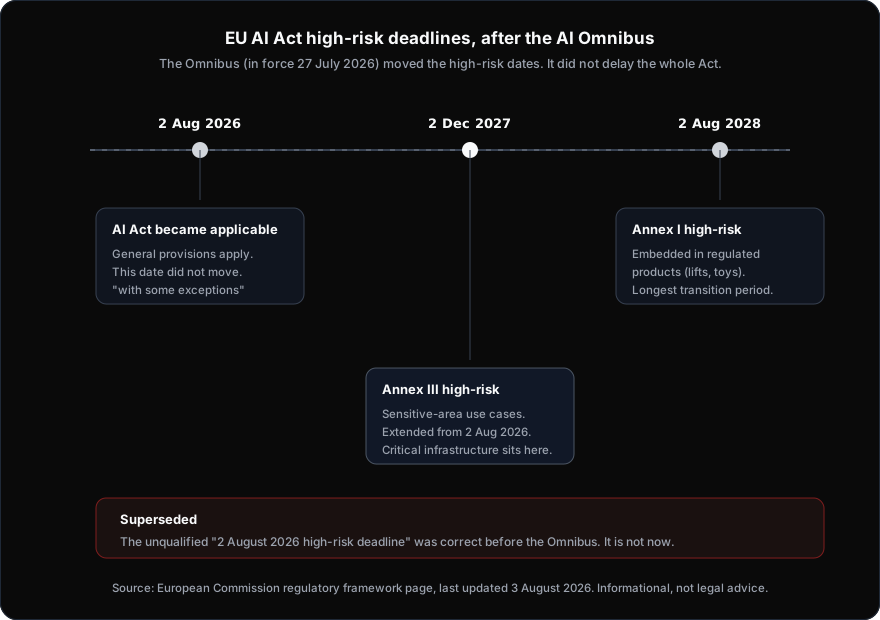
- The high-risk deadlines moved, and most competitor pages are now wrong. The European Commission's regulatory framework page (last updated 3 August 2026) states the AI Omnibus "entered into force on 27 July 2026" and that "the rules for high-risk use cases in certain sensitive areas (Annex III) have been extended to 2 December 2027," with Annex I product-embedded systems extended "until 2 August 2028." Any page citing 2 August 2026 as the high-risk deadline is out of date.
- The Act itself became applicable on 2 August 2026. The same page states the "AI Act entered into force on 1 August 2024 and became applicable on 2 August 2026, with some exceptions." The Omnibus did not delay the whole Act, only the high-risk transition periods.
- Most AI SRE agents are not high-risk under the wording as written. The Commission defines high-risk as "AI use cases that can pose serious risks to health, safety or fundamental rights." A read-only investigation agent that suggests fixes for a human to approve does not fit the Annex III categories on its face.
- Scope is the real question, and it is not settled by marketing. Annex III names critical infrastructure among high-risk areas. Whether an agent that touches infrastructure falls inside depends on the "safety component" test and the Article 6(3) carve-out for a system "intended to perform a narrow procedural task."
- If an agent is in scope, three obligations dominate. Human oversight so a person "can intervene in the operation" or interrupt "through a 'stop' button" (Article 14), automatic event logging over the system lifetime (Article 12), and log retention.
- This is not legal advice. It states what the primary texts say and where they leave judgment to the deployer. A compliance decision needs counsel who has read your specific deployment.
The EU AI Act is the European Union's regulation of AI systems by risk tier, and as of the 2026 AI Omnibus its strictest obligations for high-risk systems apply from 2 December 2027 rather than the originally scheduled 2 August 2026. For teams running AI agents against production infrastructure, the practical questions are two: is the agent in scope at all, and if it is, what does the law actually require. The dates matter because most content published before 27 July 2026 now carries superseded deadlines.
This post works from the primary texts: the Official Journal consolidation of the Act, the amending regulation, and the Commission's own summary. Where the law leaves a judgment to the deployer, that is stated rather than resolved.
What did the AI Omnibus change, and when?
The Commission's regulatory framework page is the clearest primary summary. It records that the amending proposal, "dubbed as the 'AI Omnibus,' was adopted on 19 November 2025," that "a political agreement was reached on 7 May 2026," and that it "entered into force on 27 July 2026." The consolidated Act text carries the same 27 July 2026 consolidation date.
The substance for operations teams is the transition periods. The Commission states plainly:
"the rules for high-risk use cases in certain sensitive areas (Annex III) have been extended to 2 December 2027"
and, for systems embedded in regulated products:
"the rules for high-risk AI systems embedded into regulated products (Annex I) have an extended transition period until 2 August 2028"
What did not move is the Act's general applicability. The page states the "AI Act entered into force on 1 August 2024 and became applicable on 2 August 2026, with some exceptions." So the prohibited-practices and general-purpose-model provisions run on their earlier timeline, and only the high-risk obligations gained the later dates.
| Milestone | Date | Source |
|---|---|---|
| AI Act entered into force | 1 August 2024 | EC framework page |
| AI Act became applicable | 2 August 2026 | EC framework page |
| AI Omnibus entered into force | 27 July 2026 | EC framework page |
| Annex III high-risk rules apply | 2 December 2027 | EC framework page |
| Annex I product-embedded high-risk rules apply | 2 August 2028 | EC framework page |
The single most common error in circulation is treating 2 August 2026 as the high-risk deadline. It was, before the Omnibus. It is not now.
Is an AI SRE agent a high-risk AI system?
This is the question that decides whether any of the heavy obligations apply, and the honest answer is that it depends on the deployment, not on the vendor category.
The Commission defines the tier by outcome: high-risk covers "AI use cases that can pose serious risks to health, safety or fundamental rights." The specific categories live in Annex III, and the Commission's own list of high-risk areas names "biometrics, critical infrastructure, education, employment, migration, asylum and border control." Critical infrastructure is the category an operations team would look at first.
Two things narrow that quickly. First, Annex III's critical-infrastructure entry is about AI used as a safety component in the management and operation of infrastructure, with the Commission's plain-language example being transport. An agent that reads logs, correlates a deploy with an error spike, and proposes a fix for a human to approve is not obviously a safety component of the infrastructure it observes.
Second, Article 6(3) provides an explicit carve-out. An Annex III system is not high-risk where it "does not pose a significant risk of harm to the health, safety or fundamental rights of natural persons," including where "the AI system is intended to perform a narrow procedural task" or to "improve the result of a previously completed human activity." An investigation agent whose output is a cited hypothesis reviewed by an on-call engineer fits the second description more naturally than it fits the safety-component test.
The defensible reading: a read-only or human-gated AI SRE agent on an ordinary application stack is unlikely to be high-risk under the wording as written, while an agent wired to take autonomous action inside genuinely critical infrastructure moves toward the line. The category label "AI SRE" does not settle it. The deployment does, and that determination belongs to counsel.
What does the Act require if an agent is in scope?
If a deployment does fall inside Annex III, three provisions do the most work for an operations team, and each has direct design consequences.
Human oversight. Article 14(1) requires that high-risk systems "be designed and developed in such a way" that "they can be effectively overseen by natural persons during the period in which they are in use." Article 14(4)(e) is more concrete: a human must be able "to intervene in the operation of the high-risk AI system or interrupt the system through a 'stop' button or a similar procedure that allows the system to come to a halt in a safe state." An agent that can take a mutating action with no interactive human present is in tension with this by construction.
Record-keeping. Article 12(1) requires that high-risk systems "shall technically allow for the automatic recording of events (logs) over the lifetime of the system." This is an audit-trail obligation, and it is one an operations team should be able to meet, since logging what an agent did is table stakes for trusting it at all.
Retention. Logs are not write-only. The Act carries a retention obligation for those records, so the design question is not just whether events are captured but for how long they are kept and who can read them.
These three shape a specific architecture: a hard boundary where a human approves any change that touches production, an event record that survives the investigation, and a retention policy behind it. That architecture is defensible practice regardless of whether the Act ultimately applies, which is the point of building it before the deadline forces the question.
How does an open-source, human-gated agent map to these obligations?
The oversight and logging provisions reward a specific design choice: keep the human on every action that touches production, and record what the agent did in a form that outlives the incident. This is a place where the open-source posture is more than a licensing preference. When the code is readable, a compliance reviewer can confirm where the human-approval boundary sits rather than taking a vendor's word for it.
Aurora is built around a human-approval boundary rather than autonomy. It suggests a fix and can open a remediation pull request on GitHub, gated on human approval, with no auto-merge. Structured mutating writes are denied when no interactive human is present, which is the same property Article 14(4)(e) is reaching for: a system that cannot commit an unattended change has a stop condition built into its default rather than bolted on. Its audit events are recorded and fingerprinted without logging raw command content, which speaks to Article 12's recording requirement while keeping sensitive command text out of the log. These are behavioural claims you can verify against the open repository rather than assertions in a datasheet, and the accountability guide covers what such a record can and cannot prove.
The honest limit: no product, Aurora included, makes a deployment compliant on its own. Compliance is a property of how the system is deployed, overseen, and documented in a specific organisation. A tool can make the human-oversight and logging obligations easier to satisfy. It cannot make the scope determination for you.
What should a reliability team do before December 2027?
Ordered by leverage, not urgency, since the deadline is far enough out that panic is the wrong response.
- Determine scope with counsel, in writing. The Article 6(3) carve-out and the Annex III safety-component test are the two hinges. Get a documented view of whether your agent is in scope before designing around obligations that may not apply.
- Put a human on every production-mutating action now. This is defensible regardless of the scope answer, and it is what Article 14 requires if the answer is yes. Retrofitting it later is harder than starting with it.
- Record what the agent did, and keep it. Automatic event logging over the system lifetime is an Article 12 obligation for in-scope systems and good operational hygiene for every system. Decide retention deliberately.
- Fix your published dates. If your team's internal wiki or public content still says 2 August 2026 for high-risk, correct it to 2 December 2027 for Annex III and 2 August 2028 for Annex I.
- Watch for the standards. Harmonised standards and guidance will fill in what "effective oversight" and "automatic recording" mean in practice. Treat today's design as a defensible default, not a final answer.
The summary
The AI Omnibus moved the high-risk deadlines to 2 December 2027 for Annex III and 2 August 2028 for Annex I, while the Act itself became applicable on 2 August 2026. Most AI SRE agents, read-only or human-gated, are unlikely to be high-risk under the wording as written, but scope is a deployment-specific legal determination and not a category label. For any agent that is in scope, the obligations that bite are human oversight with a stop condition, automatic event logging, and retention. All three are worth building before the deadline regardless, because they are also what makes an agent trustworthy in production.
Run a human-gated agent against your own stack
Aurora is Apache 2.0, so you can inspect exactly where the human-approval boundary sits rather than trusting a description of it. The only external requirement is one LLM API key; cloud connectors are optional.
git clone https://github.com/arvo-ai/aurora.git && cd aurora

make init                # generates secrets, copies .env.example to .env
nano .env                # add OPENROUTER_API_KEY (or OPENAI_API_KEY / ANTHROPIC_API_KEY)
make prod-prebuilt       # pulls prebuilt images from GHCR and starts
Open http://localhost:3000. The first user to register becomes admin.
- Start free: aurora-ai.net (hosted, no infrastructure to run)
- GitHub: github.com/Arvo-AI/aurora
- Related guides: Who Is Accountable When an AI Agent Changes Prod? · AI Agent Guardrails in Production · Open Source Incident Management · Self-Hosted AI SRE
Sourcing note. Dates and applicability come from the European Commission's regulatory framework page (last updated 3 August 2026) and the Official Journal consolidation of Regulation (EU) 2024/1689 dated 27 July 2026. Obligation wording is quoted from Articles 12, 14, and 6(3) of that text. This post is informational and not legal advice. Verified August 22, 2026.