Parallel-Agent Incident Investigation: AWS vs BigPanda
In September 2026 AWS and BigPanda both shipped multi-agent parallel incident investigation. What each launched, how the architectures differ, and when parallel helps.
Key Takeaways
- In September 2026, two vendors shipped parallel-agent incident investigation within weeks of each other. BigPanda announced Swarm Investigation on 4 September, and AWS introduced Amazon CloudWatch Omni with an embedded DevOps Agent on 22 September.
- BigPanda's model runs multiple agents against competing hypotheses at once. Swarm Investigation "coordinates specialized AI agents to investigate multiple plausible causes in parallel, evaluate evidence as it emerges."
- AWS's model embeds one collaborating agent in an investigation session. The Amazon DevOps Agent "participates alongside your team in investigation sessions, correlating signals and suggesting next steps."
- Both keep the human in the loop for action. AWS describes the agent as "suggesting next steps"; neither product is described as acting on production without human review.
- Parallel investigation is a real capability, not a free one. Running many agents multiplies token cost and can produce conflicting findings, which is why an orchestrator is worth making opt-in rather than the default.
- Availability differs. BigPanda states Swarm Investigation "is generally available"; AWS states CloudWatch Omni is now available and the DevOps Agent "is enabled by default in every Omni investigation session."
- The design question is when parallel helps. Multiple hypotheses genuinely benefit from parallel agents; a single clear signal does not, and paying for a swarm to chase it wastes budget.
Parallel-agent incident investigation is an architecture where several AI agents work different hypotheses or data sources at the same time and pool their findings, rather than one agent reasoning step by step. In September 2026 both BigPanda and AWS shipped a version of it. For SREs evaluating AI investigation tooling, the two launches make a useful contrast: one vendor coordinates a swarm of specialized agents, the other embeds a single collaborating agent in a shared session.
What did BigPanda and AWS launch in September 2026?
Two different takes on putting AI agents into the investigation loop, weeks apart.
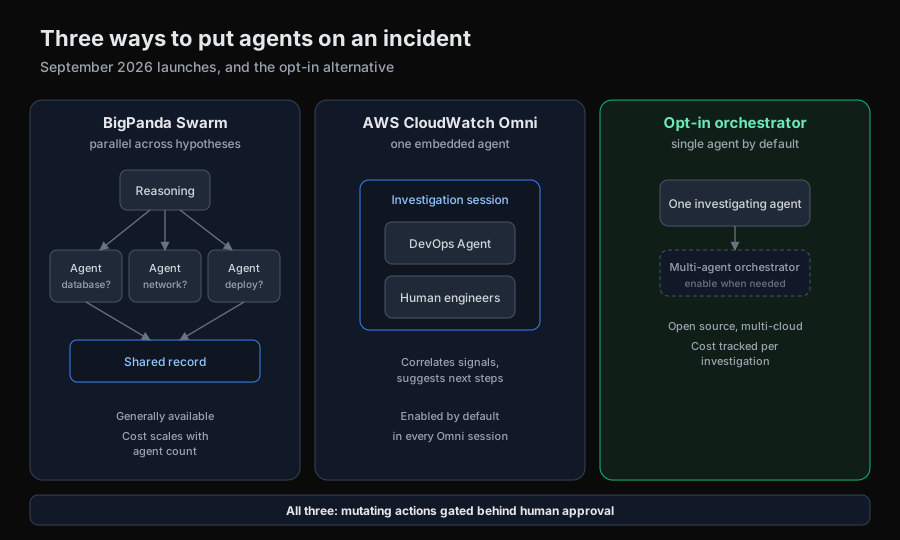
BigPanda announced Swarm Investigation on 4 September 2026. Per the post, it "coordinates specialized AI agents to investigate multiple plausible causes in parallel, evaluate evidence as it emerges." A Reasoning Engine "coordinates new investigation tasks" while individual investigation agents run focused tasks against connected tools and feed findings into a shared record. BigPanda states the feature "is generally available as part of AI Incident Assistant, and does not require a separate license."
AWS introduced Amazon CloudWatch Omni on 22 September 2026, with an embedded Amazon DevOps Agent. The post describes the agent this way: it "participates alongside your team in investigation sessions, correlating signals and suggesting next steps," and "identifies correlated events across services, traces root cause paths through your dependency graph, and maintains investigation history for post-incident review." AWS says the DevOps Agent "is enabled by default in every Omni investigation session." AWS states CloudWatch Omni is now available and can be tried from the console.
How do the two architectures differ?
BigPanda parallelizes across hypotheses; AWS embeds a single collaborator in a session. That is the core distinction, and it shapes everything downstream.
| Dimension | BigPanda Swarm Investigation | AWS CloudWatch Omni + DevOps Agent |
|---|---|---|
| Announced | 4 September 2026 | 22 September 2026 |
| Agent model | Multiple specialized agents in parallel | One agent embedded in the session |
| What it does | Investigates "multiple plausible causes in parallel" | "correlating signals and suggesting next steps" |
| Root cause | Evaluates evidence as it emerges across agents | "traces root cause paths through your dependency graph" |
| Human role | Investigation feeds a shared record for the team | "participates alongside your team," suggests steps |
| Stated availability | "generally available," no separate license | Omni available; DevOps Agent enabled by default |
| Action on prod | Not described as autonomous | Described as suggesting, not acting |
Both are advisory by design. Neither vendor describes its agent taking a mutating action on production without a human. AWS's language is consistently "suggesting next steps" and providing "suggestions," with humans performing the actual actions. That matches the wider 2026 pattern in which vendors gate mutation behind human approval while letting investigation run freely, a convergence covered in how vendors gate AI agent autonomy.
Does running agents in parallel make investigation better?
Sometimes, and it depends on whether the incident has one likely cause or several competing ones. Parallel agents shine when there are multiple plausible hypotheses that can be investigated independently: a swarm can chase "database", "network", and "recent deploy" at once and converge faster than a single agent working them in sequence. BigPanda's framing, "multiple plausible causes in parallel," is exactly this case.
But parallelism is not free, and more agents is not automatically better. Running several agents multiplies token cost, and coordinating them introduces its own failure modes, including agents reaching conflicting conclusions that something must reconcile. Research on multi-agent systems has documented that coordination overhead and error propagation can erode the benefit, which is why treating a swarm as the default rather than a deliberate choice is risky. That evidence is collected in why multi-agent AI systems fail in production. The defensible design position is that parallel investigation is a capability to reach for when the hypothesis space is wide, not a setting to leave on for every alert.
What should an SRE weigh when choosing parallel-agent tooling?
Four questions, each of which the two launches answer differently.
- Is the agent advisory or acting? Both BigPanda and AWS keep the agent advisory, suggesting steps rather than changing production. Confirm where any tool draws that line before trusting it near prod, because investigation autonomy and mutation autonomy are different risks.
- What does parallelism cost? A swarm multiplies LLM spend per incident. Ask whether the tool exposes per-investigation cost and whether parallelism is a default or a choice. The cost surface of a single AI investigation is broken down in what an AI investigation actually costs.
- How are conflicting findings resolved? Multiple agents can disagree. A design that pools findings into a shared record, as BigPanda describes, still needs a reconciliation step; a single-agent design sidesteps the conflict entirely.
- Is it open and portable, or tied to one stack? CloudWatch Omni lives in the AWS console and dependency graph. A tool that is open source and multi-cloud keeps the investigation portable across providers.
How does an opt-in orchestrator compare?
By making the single-agent path the default and the swarm a deliberate opt-in, which inverts the "parallel by default" assumption. Aurora runs a single LangGraph investigating agent by default and ships a multi-agent orchestrator that is opt-in rather than on out of the box. That reflects the design view above: a single agent is the right tool for most incidents, and parallel agents are worth the cost only when the hypothesis space justifies them.
Aurora is also open source and multi-cloud, so the investigation is not tied to one provider's console, and it tracks cost per investigation, which is the number that decides whether a swarm was worth running. Like both BigPanda and AWS, it keeps mutation human-gated: it denies structured mutating writes when no interactive human is present, and remediation is limited to a pull request a human merges. The point is not that a swarm is wrong, it is that whether to run one should be a choice an operator makes per incident, informed by cost, rather than a default that quietly multiplies spend. How that investigation works end to end is covered in AI-powered incident investigation, and the broader tool landscape in the best AI-powered incident investigation tools.
The summary
September 2026 saw two parallel-agent investigation launches: BigPanda's Swarm Investigation, which runs specialized agents against competing hypotheses in parallel and is generally available, and AWS's CloudWatch Omni, which embeds a single DevOps Agent in an investigation session to correlate signals and suggest next steps. Both keep the agent advisory and the human in the loop for action. Parallel investigation genuinely helps when several hypotheses compete, but it multiplies cost and adds coordination risk, so the defensible design is to make a swarm an opt-in choice per incident rather than the default for every alert.
Try Aurora
- Start free: aurora-ai.net (hosted, no infrastructure to run)
- GitHub: github.com/Arvo-AI/aurora
- Book a demo: cal.com/arvo-ai/demo
- See it on an incident: Aurora root cause analysis
Sourcing note. BigPanda Swarm Investigation quotes, the general-availability and no-separate-license statements, and the 4 September 2026 date are from BigPanda's announcement post. AWS quotes describing the Amazon DevOps Agent, the "enabled by default" statement, CloudWatch Omni availability, and the 22 September 2026 date are from the AWS News Blog post. Both were verified 24 September 2026. Aurora's single-agent default, opt-in orchestrator, cost tracking, and human-gated remediation are described from its open-source repository, where the multi-agent orchestrator is off by default.