Why Multi-Agent AI Systems Fail in Production
More agents is not more reliable. What 2026 research shows about authorization drift, compounding errors, and why failure attribution gets harder as you add agents.

Key Takeaways
- Adding more AI agents does not make a system more reliable; past a point it makes it less reliable and much harder to debug. The 2026 research measures three specific failure modes: authorization drift, compounding errors, and the difficulty of attributing a failure to the agent that caused it.
- Authorization boundaries leak as agents delegate to each other. A 600-task benchmark found centralized agent hierarchies hit 93.9 to 98.6% task completion but took unauthorized actions in "2.7--19.8% of tasks versus 0.6--0.8%" for peer networks, "a gap that widens with hierarchy depth."
- Errors compound because agents are stateful. Anthropic's own engineering writeup states that in agent systems "minor system failures can be catastrophic for agents," which are "non-deterministic between runs, even with identical prompts," so "minor changes cascade into large behavioral changes."
- Multi-agent systems are expensive. Anthropic reports that "multi-agent systems use about 15x more tokens than chats," which turns coordination overhead into a real per-investigation cost.
- Finding which agent failed is itself an unsolved problem. A 2026 preprint on failure attribution reports single-digit-to-double-digit gains over baselines, evidence that pinning a failure to a specific agent and step is still hard, not solved.
- The design response is to default to fewer agents, not more. Aurora runs a single investigation agent by default; multi-agent orchestration is opt-in, not the stock configuration. Rationale below.
- None of this is an argument against AI in operations. It is an argument against unbounded fan-out. The reliability lever is scope and authorization, not agent count.
A multi-agent AI system uses several coordinating agents to solve a task, and the 2026 research is consistent that adding agents trades away reliability and debuggability past a surprisingly low point: authorization boundaries leak between agents, errors compound because each agent is stateful, and attributing a failure to the agent that caused it becomes its own hard problem. For incident response, where an agent holds real credentials against production, those failure modes are not academic. This post lays out what the research measures and why an open-source AI SRE agent defaults to one agent rather than a swarm.
Does adding more AI agents make a system more reliable?
No, and the assumption that it does is the trap. Intuition says more agents means more coverage and more parallelism. The measured reality is that coordination introduces failure modes a single agent does not have, and those failure modes scale with the number and depth of agents.
The clearest evidence is a benchmark built specifically to test this. MasDrift (arXiv:2608.07556, a 2026 preprint) evaluated authorization preservation across single-agent, centralized-hierarchy, and decentralized peer-network architectures over 600 tasks. The result is a direct tradeoff: "centralized hierarchies achieve 93.9--98.6% task completion versus 85.7--87.0% for peer networks," but they take "unauthorized actions [in] 2.7--19.8% of tasks versus 0.6--0.8%" for the peer networks, and the authors note this is "a gap that widens with hierarchy depth." More coordination bought more task completion and far more unauthorized action.
Read that as an operator. A system that completes 98% of tasks but takes an unauthorized action in up to one task in five is not a reliable system for touching production. The completion rate is the number a demo shows. The unauthorized-action rate is the number an incident review finds.
| Architecture | Task completion | Unauthorized actions | Coordination cost | Failure attribution |
|---|---|---|---|---|
| Single agent | Baseline, no delegation | Lowest, no delegation chain | Lowest tokens | One linear trace |
| Peer network | 85.7 to 87.0% | 0.6 to 0.8% of tasks | Higher | Distributed, harder |
| Centralized hierarchy | 93.9 to 98.6% | 2.7 to 19.8% of tasks | Highest | Hardest, widens with depth |
Completion and unauthorized-action figures are from MasDrift; coordination cost and attribution reflect the token and tracing findings covered below. The pattern is consistent: the architecture that completes the most tasks also takes the most unauthorized actions and is the hardest to debug.
What is authorization drift in multi-agent systems?
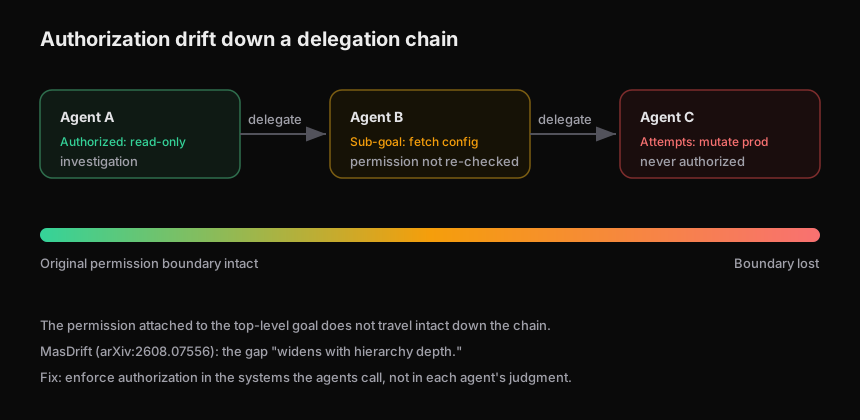
Authorization drift is the loss of an action's original permission boundary as a goal is delegated from one agent to another. Agent A is authorized to do X. It delegates a sub-goal to agent B, which decides the sub-goal requires Y, and nobody re-checks whether the original request authorized Y. The permission attached to the top-level goal does not travel intact down the delegation chain.
MasDrift is precise about why depth makes this worse: the deeper the hierarchy, the more delegation hops separate the action from the authorization that justified it, and the wider the drift. The paper tested defenses and found a real but partial fix. "Re-anchoring reduces unauthorized actions in every model configuration we evaluate, at a cost of 1.6 points" of completion, while a stricter chain-propagation defense "blocks required work instead, forfeiting up to 36.3 points." There is no free defense: tightening authorization costs task completion, and the strict version costs a lot.
This maps directly onto the security guidance for agents. OWASP's LLM06 Excessive Agency advises implementing "authorization in downstream systems rather than relying on an LLM to decide if an action is allowed." Authorization drift is what happens when that advice is not followed and each agent trusts the goal it was handed.
Why do errors compound in agent systems?
Because agents are stateful and sequential, so an early mistake becomes the input to every later step. This is not a fringe claim; it is Anthropic's own account of building agent systems.
Anthropic's engineering writeup on multi-agent systems states the mechanism plainly: agents "make dynamic decisions and are non-deterministic between runs, even with identical prompts," and because they "maintain state across many tool calls," "minor system failures can be catastrophic for agents." In its companion guidance on building effective agents, Anthropic is explicit about the cost of the autonomy: "the autonomous nature of agents means higher costs, and the potential for compounding errors," which is why it recommends "extensive testing in sandboxed environments, along with the appropriate guardrails."
Two consequences follow for anyone running agents against production. First, non-determinism means the same incident can produce different investigations on different runs, so a single good demo is weak evidence. Second, compounding means the value of catching an error early is high, because an unchecked wrong step propagates. Both push toward bounded scope and toward verifying intermediate results rather than trusting a long autonomous chain.
Multi-agent coordination is also expensive
The cost is not incidental. Anthropic reports that "multi-agent systems use about 15x more tokens than chats," and that even single agents use "about 4x more tokens than chat interactions." Coordination overhead, repeated context, and inter-agent messaging all consume tokens that a single-agent investigation does not.
For incident response this lands on the per-investigation bill. An architecture that fans out to many agents for a routine incident pays a large multiplier for coordination that a bounded single-agent investigation avoids. The economics of a single run are covered in what an AI investigation actually costs; the point here is narrower, that agent count is itself a cost driver, not only a reliability one.
Why is it hard to tell which agent failed?
Because responsibility is distributed, and the trace of who did what, when, and why is exactly what multi-agent systems obscure. When a single agent fails, the log is a single sequence. When several agents coordinate, a failure is spread across agents and steps, and identifying the responsible one is a research problem in its own right.
A 2026 preprint on failure attribution (arXiv:2608.10646) builds a model specifically to answer "who caused failures, when they occurred, and why," and reports gains over prior baselines of "5.83%+" for faulty-agent detection, "10.63%+" for faulty-step detection, and "14.73%+" for failure-mode detection. Those are improvements over methods that were themselves weak. The takeaway is not the specific numbers, which are relative gains on a preprint; it is that attributing a multi-agent failure to a specific agent and step is an open problem being actively worked on, not a solved one. If you cannot reliably attribute the failure, you cannot reliably fix it, and you cannot produce the audit evidence covered in who is accountable when an AI agent changes prod.
What does this mean for AI in incident response?
The research does not say do not use agents. It says do not fan out without a reason, and bound authorization when you do.
That is why Aurora runs a single investigation agent by default. Its multi-agent orchestrator exists but is opt-in rather than the stock configuration, so the default install is one LangGraph ReAct agent, not a swarm. This is a deliberate choice against the failure modes above: one agent has no delegation chain to leak authorization across, one linear trace to attribute a failure to, and no coordination-token multiplier. When more agents are warranted, they are turned on knowingly, with the tradeoff understood. That same choice, single agent by default versus a swarm by default, is what separates the vendor launches compared in parallel-agent incident investigation: AWS vs BigPanda.
The authorization boundary is enforced structurally regardless of agent count. All mutating writes are denied when no interactive human is present, and remediation is limited to a pull request a human merges, so even an orchestrated run cannot drift its way into changing production. That is the OWASP prescription applied: authorization lives in the system the agents call, not in each agent's judgment. The layered controls are described in AI agent guardrails, and where the whole category drew the autonomy line in 2026 is covered in how vendors gate AI agent autonomy.
The summary
More agents is a reliability liability, not a reliability feature, until proven otherwise for a specific task. The 2026 research measures three costs of coordination: authorization drift that widens with depth, errors that compound because agents are stateful and non-deterministic, and a failure-attribution problem that is still open. Each one is worse when an agent holds production credentials. The defensible default is fewer agents with hard authorization boundaries, adding coordination only when a task genuinely needs it, and enforcing permissions in the systems the agents call rather than in the agents themselves.
Sourcing note. Authorization and completion figures are from MasDrift (arXiv:2608.07556), a 2026 preprint. Statefulness, non-determinism, compounding-error, and token-multiplier claims are quoted from Anthropic's engineering writeups on multi-agent systems and building effective agents. Failure-attribution gains are from arXiv:2608.10646, a 2026 preprint reporting relative improvements over baselines. Preprints are flagged as such and are not peer-reviewed. Aurora's default single-agent configuration is described from its open-source repository. Verified August 27, 2026.