AI Agent Autonomy: How Vendors Gate It in 2026
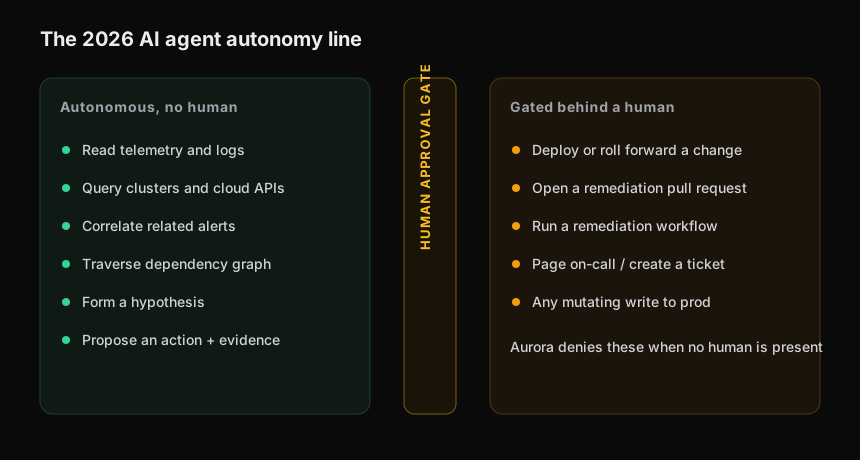
In summer 2026 four incident vendors converged on the same rule: agents investigate autonomously, but a human approves any action that changes production.

Key Takeaways
- In 2026 the autonomy line settled in the same place across the category: agents may investigate on their own, but a human approves any action that mutates production. Four vendors published the same boundary within four weeks, and the security frameworks say the same thing.
- NeuBird framed it as earned autonomy. Its August 25, 2026 post argues "an AI agent needs a ladder of trust in production just as rigorous as the one we build for human engineers," and names the first rung as autonomous rollback, "a well-scoped, reversible action."
- Dynatrace shipped autonomous agents wrapped in governance. Its July 27, 2026 Autonomous Operations launch says every action is "designed to be transparent, auditable, and governed," with "human approval and intervention where required."
- PagerDuty split triage from action. Its August 5, 2026 SRE Agent update has the agent "begin autonomous triage immediately," then "the responder reviews the recommendation, runs the workflow, and the agent confirms the fix worked."
- BigPanda gated the mutations, not the investigation. Its August 14, 2026 post lets agents "investigate multiple hypotheses simultaneously," while "mutating actions (i.e., paging on-call or creating a ticket) are governed by configurable approval policies."
- The security guidance is explicit about the same rule. OWASP's LLM06 Excessive Agency says to "require a human to approve high-impact actions before they are taken" and to "implement authorization in downstream systems rather than relying on an LLM to decide if an action is allowed."
- Aurora enforces this structurally rather than by instruction. A single chokepoint denies every mutating write when no interactive human is present, and remediation is limited to a pull request a human merges. Details and caveats below.
AI agent autonomy in incident response is the degree to which an agent can act on production without a human in the loop, and in 2026 the category converged on a narrow answer: investigation is autonomous, but any action that changes production waits for a human to approve it. That boundary is not a marketing accident. Four incident vendors published it within four weeks of each other in summer 2026, and the security frameworks that cover autonomous agents describe the same control in near-identical language.
This post maps where each vendor actually draws the line, separates the claim from the mechanism, and states plainly how an open-source agent enforces the same boundary.
Why did every AI SRE vendor gate autonomy the same way in 2026?
Because the failure mode is shared, and so is the fix. An agent that reads infrastructure is low risk. An agent that changes it holds the same power as a privileged human and none of the accountability, so the industry landed on the oldest control in operations: a human approves the change.
The convergence is dense enough to date. NeuBird published its earned-autonomy argument on August 25, 2026. Dynatrace launched Autonomous Operations on July 27, 2026. PagerDuty shipped its SRE Agent triage and access-control update on August 5, 2026. BigPanda rearchitected its AI Incident Assistant on August 14, 2026. Each one lets the agent investigate freely and gates the actions that touch production.
The frameworks arrived at the boundary independently. OWASP's LLM06 Excessive Agency entry lists two mitigations that read like a design spec: "utilise human-in-the-loop control to require a human to approve high-impact actions before they are taken," and "implement authorization in downstream systems rather than relying on an LLM to decide if an action is allowed or not." The second sentence is the important one. Asking the model to police itself is not a control. Enforcing permissions in the system the model calls is.
Where does each vendor actually draw the line?
The useful comparison is not "does it have autonomy" but "what can it do without a human, and what waits." The table below uses each vendor's own published wording from the sources above.
| Vendor | Autonomous without a human | Gated behind a human | Source date |
|---|---|---|---|
| NeuBird | Investigation; proposes autonomous rollback as the first earned privilege | Broader action, until trust is "earned" up a "ladder of trust" | Aug 25, 2026 |
| Dynatrace | Triage that "triggers autonomously on newly detected problems" | Remediation, with "human approval and intervention where required" | Jul 27, 2026 |
| PagerDuty | "Autonomous triage immediately" when an incident triggers | Workflow execution: "the responder reviews the recommendation, runs the workflow" | Aug 5, 2026 |
| BigPanda | Multi-hypothesis "Swarm Investigation" | "Mutating actions ... are governed by configurable approval policies" | Aug 14, 2026 |
| Aurora | Read-only investigation across connected clouds and Kubernetes | All mutating writes when no human is present; remediation via human-merged PR | Repository |
Two patterns fall out of the table. First, nobody gates investigation. Reading logs, querying a cluster, correlating alerts, and forming a hypothesis are treated as safe for an agent to do alone, and the whole category agrees. Second, the disagreement is only about what counts as an action. BigPanda counts paging a human and opening a ticket as mutating actions worth an approval policy. NeuBird counts rollback as safe enough to be the first thing an agent earns, on the argument that undoing a known-bad change is reversible by definition.
Is gated autonomy the same as no autonomy?
No, and the distinction matters for buyers. A gated agent still removes most of the manual work of an incident. It reads the telemetry, runs the queries a responder would run, and arrives at the approval step with a proposed action and the evidence behind it. What it does not do is press the button.
PagerDuty's wording captures the split precisely: the agent begins "autonomous triage immediately," and "investigation and analysis can be well underway before a responder ever acknowledges the page," but the mutation still routes through a person who "reviews the recommendation, runs the workflow." The time saved is the investigation time. The human keeps the decision.
Google's graded autonomy framework formalizes this as a ladder from L0 (everything human) to L4 (the agent devises and executes). Its L2 requires a human to "explicitly Approve any plan before the system proceeds with an actuation." What makes Google's version credible is the machinery around the higher rungs: an agent that "detects an elevated risk score or an anomalous production state" automatically "downgrade[s] the request" back to human approval, and there are "emergency 'Red Button' endpoints" to "instantly pause all in-flight agentic actions." Autonomy that can be revoked in one action is a different risk than autonomy that cannot.
What does earned autonomy actually require?
NeuBird's phrase is the sharpest framing in the batch, so it is worth taking literally. Its post argues that "an AI agent needs a ladder of trust in production just as rigorous as the one we build for human engineers," and that the first privilege an agent should earn is autonomous rollback, because "if an agent can prove with confidence that a specific change caused an incident, undoing that change is a well-scoped, reversible action."
The load-bearing word is reversible. A rollback to a known-good state is bounded: the worst case is a return to the state five minutes ago. An open-ended fix is not bounded, because the agent is composing a new action whose blast radius it cannot fully predict. Earned autonomy, read carefully, is not a trust score attached to a model. It is a claim about the reversibility of a specific action class. That is a more defensible line than "the agent is 95% accurate, so let it act," because reversibility is a property of the operation, not an estimate of the model.
It also exposes what earned autonomy is not. It is not the same as an eval score. No commercial AI SRE agent has been submitted to an independent third-party benchmark, a gap covered in AI SRE accuracy. Autonomy earned on the reversibility of the action survives that gap. Autonomy justified by an unpublished accuracy figure does not.
How does an open-source agent enforce the line?
Everything above is a claim a vendor makes in a blog post. In an open-source agent the boundary is readable in source rather than asserted, which is the reason to describe Aurora here concretely rather than abstractly.
Aurora enforces the boundary at a single structural chokepoint rather than through a system-prompt instruction. When no interactive human is present in a session, all structured mutating writes are denied, so a background run cannot decide to change production on its own. This is the mechanism OWASP describes: authorization enforced in the system the model calls, not a request that the model behave. A prompt telling an agent not to act is exactly the control that failed in the Replit database deletion, where an agent deleted a production database during an explicit code freeze.
Remediation follows the same rule. Aurora suggests a fix and can open a remediation pull request on GitHub or Bitbucket, gated on human approval, with no auto-merge. The alert-correlation engine links related alerts into an investigation and never suppresses or mutes them, so the agent cannot silence a signal on its own. Command execution can run in a sandboxed Kubernetes pod when ENABLE_POD_ISOLATION is enabled, and destructive actions are human-gated regardless. None of that requires trusting an accuracy number, because none of it lets the agent mutate production without a person.
For the layered version of the runtime controls, see AI agent guardrails. For what an agent owes the human it wakes at the approval step, see the agent-to-human handoff. For where remediation fits, see automated incident remediation and the root cause analysis guide for SREs.
What should a buyer ask in 2026?
The convergence makes the buying question concrete. Every vendor now says it gates autonomy, so the differentiator is how, not whether.
- What exact action classes can the agent perform with no human? Get the list, not the adjective. "Autonomous" without a list of permitted mutations is not an answer.
- Is the gate enforced in the executing system or in the prompt? Prompt-level gates are the control that failed at Replit. Ask where authorization lives.
- Can the whole thing be stopped in one action? Google publishes a red button. Ask for the equivalent.
- Is any autonomous action reversible by construction? Rollback is. An open-ended fix is not. Grade the two differently.
- Is the boundary auditable, or do you take it on trust? In an open-source agent the answer is readable in source. In a closed product it is a promise.
The summary
The 2026 story is not that AI SRE agents became autonomous. It is that the whole category agreed on where autonomy stops. Investigation runs without a human. Anything that changes production waits for one. NeuBird, Dynatrace, PagerDuty, and BigPanda published that boundary within a month of each other, and OWASP and Google describe the same control. The remaining question for a buyer is purely mechanical: what can the agent do alone, where is that limit enforced, and can it be revoked in a single action. A vendor that answers those three cleanly has a defensible autonomy story. One that answers with an accuracy percentage does not.
Sourcing note. Vendor positions are quoted verbatim from primary posts dated July 27 to August 25, 2026: NeuBird, Dynatrace, PagerDuty, and BigPanda. Framework language is from OWASP's LLM06 Excessive Agency entry and Google's graded autonomy framework. Aurora's behavior is described from its open-source repository. No Aurora accuracy or MTTR figure is claimed, because no such benchmark exists. Verified August 27, 2026.