AI Tools That Write Postmortems Automatically (2026)
Yes, several tools draft the post-mortem from the incident timeline. The 9 best AI post-mortem tools ranked, with exports, pricing and Jeli's EOL deadline.

Key Takeaways
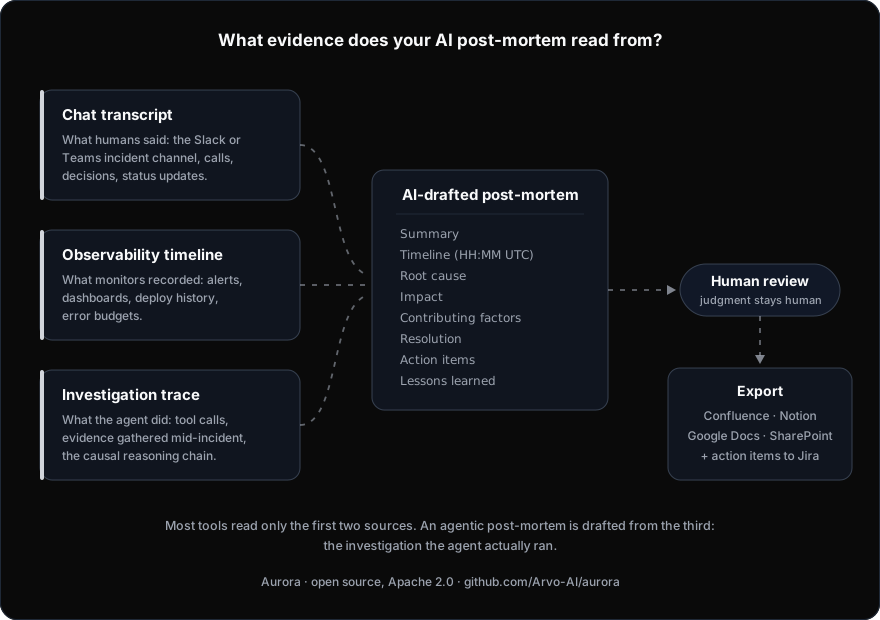
- The best AI post-mortem tools in 2026 are Aurora, Rootly, incident.io, Datadog, FireHydrant, PagerDuty, Atlassian JSM, Xurrent IMR, and Grafana IRM. They differ less in output than in evidence: most draft from the incident chat channel, a few draft from observability data, and only an agentic tool drafts from an investigation it actually ran.
- A deadline is reshaping the category. PagerDuty's Jeli, the best-known dedicated post-incident review product, reaches end of life on December 22, 2026, replaced by post-incident reviews in PagerDuty's web UI.
- Consolidation ate the independents. Blameless was absorbed by FireHydrant in 2024, and FireHydrant itself was acquired by Freshworks, announced December 2025 and closed January 2026.
- Check the tier before you budget. FireHydrant's AI retrospectives are Enterprise-only, incident.io's AI unlocks at Pro, $25/user/month, Datadog Incident Management is $30/seat/month billed annually, and Aurora is open source (Apache 2.0) with post-mortem generation included.
- Every tool on this list keeps a human in the loop. AI drafts; a person reviews, edits, and owns the lessons. That is by design, not a limitation.
Nobody loves writing post-mortems, which is why every incident-management vendor now sells software to draft them. An AI post-mortem tool automatically drafts an incident retrospective, the summary, timeline, root cause, impact, action items, and lessons learned, from evidence collected during the incident, leaving a human to review and finish it. This list ranks the nine tools that genuinely ship that capability in 2026, verified against each vendor's live documentation on July 15, 2026.
A disclosure up front: Arvo builds Aurora, which is ranked first. The same criteria are applied to every tool, competitor strengths are stated plainly, and every claim links to a source.
How we ranked the AI post-mortem tools
Five criteria, weighted in this order:
- Evidence source. What the AI actually reads when it drafts. Chat transcripts, observability timelines, or an investigation trace. Our automated post-mortem generation guide calls this the Postmortem Provenance Model, and it is the single biggest differentiator between tools.
- Draft completeness. Which sections the AI fills in versus leaves as headings.
- Export targets. A post-mortem nobody can find teaches nobody anything. Confluence, Notion, Google Docs, SharePoint.
- Human-review workflow. Suggested edits you accept or reject beat a wall of generated text.
- Pricing clarity. Which tier the AI features actually unlock at.
Quick comparison
| Tool | AI drafts from | Export targets | AI unlocks at | Open source? |
|---|---|---|---|---|
| Aurora | Its own investigation trace + Slack context | Confluence, Notion, SharePoint | Free, included | Yes (Apache 2.0) |
| Rootly | Alerts, chat, commits | Confluence, Notion, Google Docs, SharePoint | AI tier: contact sales | No |
| incident.io | Incident data + call transcripts (Scribe) | Confluence, Notion, Google Docs, SharePoint | Pro, $25/user/mo | No |
| Datadog | Incident timeline (10+ messages) | Notebooks, Confluence, Google Drive | $30/seat/mo (annual) | No |
| FireHydrant | Incident data + call transcription | Confluence, Google Docs, PDF | Enterprise only | No |
| PagerDuty | Incident data + Scribe transcripts | PagerDuty PIRs (Jeli EOL Dec 2026) | AI Actions credits | No |
| Atlassian JSM | Incident context via Rovo Ops | Confluence, Jira action items | Premium/Enterprise | No |
| Xurrent IMR | Logs, metrics, Slack/Teams | Markdown, PDF | From $6/user/mo | No |
| Grafana IRM | Sanitized incident timeline | Grafana Incident | Grafana Cloud | No |
The 9 best AI post-mortem tools in 2026
1. Aurora: post-mortems drafted from the investigation itself
- What it drafts: When an incident is resolved, Aurora's default-enabled "Generate Postmortem" action drafts the full document: summary, timestamped timeline, root cause, impact, contributing factors, resolution, action items as checkboxes, and lessons learned. The difference is provenance: the draft is composed from the investigation the agent actually ran, its tool calls, the evidence they returned, and the reasoning chain, plus human context pulled from Slack during the incident window.
- Review and export: Documents are versioned, editable, and export to Confluence, Notion, or SharePoint. Templates are customizable per organization.
- Pricing and license: Open source, Apache 2.0, self-hosted, free. You pay for infrastructure and LLM tokens.
- Watch out for: Aurora is an investigation platform that generates post-mortems, not a standalone retrospective editor. If you only want AI drafting bolted onto your existing incident tool, a lighter option below fits better.
2. Rootly: the most complete chat-transcript retrospective suite
- What it drafts: Rootly retrospectives build an AI timeline from alerts, chat, and commits, then draft summaries, root cause, and action items. Its steerable "AI blocks" let you define per-template what each AI section should cover, the most editorial control in the category.
- Review and export: Exports to Confluence, Notion, Google Docs, and SharePoint, with bidirectional Jira and Linear sync for action items.
- Pricing: Incident Response Essentials is $20/user/month; the AI tier is contact-sales.
- Watch out for: The AI features have no public price. Our Rootly alternative guide covers the open-source route.
3. incident.io: AI drafts with inline review
- What it drafts: AI post-mortems generate a first draft from incident data, with an inline AI review that suggests improvements you accept or reject, and Scribe transcribes incident calls so spoken decisions make it into the document.
- Review and export: Exports to Confluence, Notion, Google Docs, and SharePoint.
- Pricing: AI features unlock at Pro, $25/user/month; Scribe is Pro and Enterprise.
- Watch out for: Drafts come from what the channel and calls captured; infrastructure facts nobody said out loud stay out of the document. See our incident.io alternative guide.
4. Datadog Incident Management: observability-stitched drafts
- What it drafts: Datadog fills post-mortem templates with six AI variables, summary, system overview, key timeline, customer impact, action items, and lessons learned, powered by Bits AI, with an out-of-the-box "General incident with AI content" template. Suggested values are accepted, edited, or rejected before saving.
- Review and export: Generates post-mortems to Datadog Notebooks, Confluence, or Google Drive.
- Pricing: Incident Management is $30/seat/month billed annually; Incident AI requires the Slack integration.
- Watch out for: The docs require at least 10 timeline messages before AI variables generate content, and the strongest results assume your evidence already lives in Datadog. Our Datadog Bits alternative guide covers the investigation side.
5. FireHydrant: AI retrospectives, now under Freshworks
- What it drafts: AI-drafted retrospectives with automatic timeline, root-cause draft, and suggested action items, plus incident call transcription.
- Review and export: Retrospectives share out through Confluence, Google Docs, PDF export, or direct links.
- Pricing: AI features are Enterprise-tier only; Pro is $25/responder/month billed annually.
- Watch out for: Corporate motion. FireHydrant absorbed Blameless in 2024 and was itself acquired by Freshworks, announced December 2025 and closed January 2026, with FireHydrant becoming the structured incident-response layer inside Freshservice. Roadmap questions belong in your evaluation. See our FireHydrant alternative guide.
6. PagerDuty: strong drafting, but Jeli sunsets in December 2026
- What it drafts: PagerDuty's Scribe Agent transcribes incident calls in real time, capturing context and timeline details that feed post-incident reviews. The dedicated Jeli platform, the most respected name in post-incident analysis, is being wound down: Jeli reaches end of life on December 22, 2026, replaced by post-incident reviews in PagerDuty's web UI, currently in early access.
- Pricing: AI usage is billed through AI Actions credits bundled into PagerDuty's paid plans, with the PagerDuty Advance add-on priced by sales.
- Watch out for: If you run Jeli today, you have a migration to plan before December 22, 2026, and it is worth evaluating the whole market before defaulting to the in-suite replacement. Our PagerDuty alternative guide covers the investigation layer.
7. Atlassian Jira Service Management: PIRs where your tickets live
- What it drafts: Atlassian Intelligence generates incident summaries for post-incident reviews, and the Rovo Ops agent pre-populates a PIR work item from incident context, and on request creates the Confluence page and files Jira tickets for extracted action items.
- Pricing: Atlassian Intelligence is automatically activated on Premium and Enterprise plans.
- Watch out for: This is summary-and-scaffolding AI rather than a full drafted retrospective; the narrative sections remain largely human work.
8. Xurrent IMR (formerly Zenduty): budget AI post-mortems
- What it drafts: Xurrent's AI compiles post-mortem reports from logs, metrics, and Slack or Teams conversations, following your templates. Zenduty now operates as Xurrent IMR, and its product pages carry the "formerly Zenduty" branding.
- Review and export: Markdown and PDF export.
- Pricing: From $6/user/month (Starter) and $16/user/month (Growth), the lowest entry price on this list.
- Watch out for: Export targets are thin (no Confluence, Notion, or Google Docs push), and confirm with sales which tier your AI features land on.
9. Grafana IRM: AI summaries at resolution
- What it drafts: Grafana IRM's OpenAI integration generates a post-incident summary on demand when you resolve an incident, sanitizing and compressing the incident timeline before processing it with OpenAI.
- Watch out for: This is summary-level AI, not full retrospective drafting; Grafana's own docs caution that generated summaries can be inaccurate or incomplete. Include it if you already run Grafana Cloud IRM; do not adopt it for post-mortems alone.
Excluded, and why: Better Stack documents its core post-mortem workflow as a manual Markdown comment on the incident, with AI drafting pitched as part of its separate AI SRE agent product rather than the post-mortem feature itself. As of July 2026, Squadcast (now SolarWinds Incident Response) documents template auto-population with the remaining details filled in manually. Blameless no longer exists as a standalone product.
Which AI post-mortem tool should you choose?
Match the tool to where your incident evidence actually lives:
- Incidents resolved by deep infrastructure investigation: the post-mortem should record what the investigation found, not what the channel said. That is the agentic lane, and Aurora is the open-source option in it; the draft cites the agent's own evidence trail.
- Incidents resolved in the chat channel: Rootly and incident.io are the strongest dedicated products, with FireHydrant competitive if you are already heading into the Freshworks ecosystem.
- Incidents that live entirely in one observability platform: Datadog's template variables give the tightest monitor-to-document fidelity.
- Incidents tracked in ITSM: Atlassian's Rovo Ops keeps PIRs, Confluence, and Jira action items in one motion.
Whatever you pick, the Google SRE book's postmortem chapter still defines the goal: blameless learning. AI changes who types the first draft. It does not change what the document is for.
- Start free: aurora-ai.net (hosted, no infrastructure to run)
- GitHub: github.com/Arvo-AI/aurora
- Related guides: Automated Post-Mortem Generation · 10 Best AI-Powered Incident Investigation Tools · AI SRE Complete Guide · 15 Best AI SRE Tools
All claims sourced from official vendor documentation and pricing pages. Feature availability and pricing change; check the linked pages before purchasing. Last verified: July 15, 2026.