
Key Takeaways
- A single defect in an automated blast radius calculation turned a routine repair into a regional outage, because the safety check validated each device on its own and never evaluated the aggregate effect. Microsoft's own post-incident review (tracking ID ZJV6-SGG) states the defect "incorrectly expanded the scope of the repair event to include all optical devices."
- The safety validation was structurally blind to the failure. The PIR states the checks "validated each device individually rather than evaluating the aggregate effect of isolating all devices at once," a scenario the system "was never designed to process."
- The automated rollback then failed for a predictable reason: it ran over the connectivity it had just severed. Microsoft states that "because that system depended on the same datacenter connectivity that had been disrupted, its automated rollback attempts were unsuccessful."
- Impact ran from 14:44 to 19:41 UTC on 23 July 2026 in the West US region, per the PIR, and was mitigated only after engineers manually correlated the fault to the original repair and rolled back by hand.
- The two design lessons are general, not Azure-specific. A check that clears each unit individually can still approve an action that is catastrophic in aggregate, and a recovery path that depends on the system it is repairing will fail exactly when it is needed.
- The containment lever is a bounded blast radius plus a human gate on mutating actions. An AI SRE that suggests a fix and opens a pull request a human merges cannot over-scope its way into an outage the way a fully automated repair loop can.
- This is a vendor-documented incident, reported here from Microsoft's published PIR. No customer counts, percentages, or third-party numbers are asserted beyond what the PIR states.
Blast radius is the set of systems an action can affect, and automated remediation is only as safe as the calculation that bounds it. Azure's West US outage on 23 July 2026 is a vendor-documented case where a defect in that calculation expanded a targeted repair to every optical device leaving a datacenter, and the automated rollback then failed because it depended on the connectivity the repair had cut. Microsoft published the full sequence in its post-incident review. The failure modes it describes are the reason automated incident remediation needs a bounded scope and a human gate rather than an unattended repair loop.
What happened in the Azure West US outage on 23 July 2026?
A break-fix repair on network hardware triggered an automated system that miscalculated which devices the repair would touch. According to Microsoft's post-incident review, "a defect in our blast radius analysis system incorrectly expanded the scope of the repair event to include all optical devices" egressing a specific datacenter. Instead of isolating the intended hardware, the action cut network paths in and out of the region.
The PIR is specific about the window. Between 14:44 and 19:41 UTC on 23 July 2026, a subset of customers in the West US region "experienced connectivity failures, increased latency, and/or difficulty accessing Azure services." Traffic staying inside the region was unaffected; the damage was to traffic entering or leaving it.
The incident is worth studying precisely because it was not a model, an attacker, or a novel bug. It was an automation doing exactly what it was told, over a scope it should never have been allowed to select.
How did an automated repair expand its own blast radius?
The safety check was correct for one device and wrong for all of them at once. Microsoft states the validation "validated each device individually rather than evaluating the aggregate effect of isolating all devices at once," and that this case "was not accounted for because the system was never designed to process a full datacenter's worth of devices in a single request."
This is the core lesson, and it generalizes far beyond optical hardware. A per-unit safety check answers the question "is it safe to change this one thing?" It does not answer "is it safe to change all of these things together?" The two questions have different answers whenever the units share a dependency, and network egress paths always do. An automated system that only asks the first question will approve an aggregate action that no operator would have signed off on.
| The check the system ran | The check it needed |
|---|---|
| Is isolating this device safe on its own? | Is isolating this set of devices safe together? |
| Passed for every device individually | Would have failed for the aggregate |
| Scope selected by an automated calculation | Scope bounded and reviewed before execution |
| Never designed for a full datacenter in one request | Must refuse or escalate an out-of-envelope request |
The design fix Microsoft lists is to block simultaneous changes across all diverse paths and to add input validation so a single request cannot select an entire datacenter's devices. The behavioral principle underneath it is that a blast radius calculation has to be evaluated in aggregate and bounded by an envelope the automation cannot exceed on its own.
Why did the automated rollback fail?
Because the rollback ran over the same infrastructure the repair had broken. Microsoft states plainly that "because that system depended on the same datacenter connectivity that had been disrupted, its automated rollback attempts were unsuccessful." The recovery system kept retrying against connectivity that no longer existed.
The timeline shows the cost of that dependency. Automated recovery began retrying within minutes, at 14:54 UTC, but the routing anomaly was initially triaged to a different cause. Recovery was reached only after engineers "correlated the routing anomaly with the initial break-fix trigger event" at 17:19, initiated a manual rollback at 17:45, and completed it across all affected devices by 18:26. Full mitigation landed at 19:41. Microsoft's remediation list includes making the automated recovery "fail more quickly and escalate to engineers more promptly when retries" are unsuccessful, "rather than continuing to retry against disrupted connectivity."
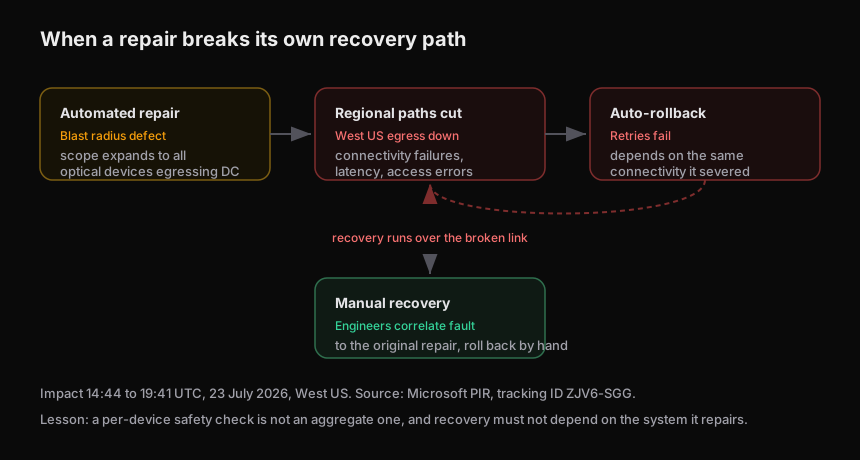
The general form of this failure is a recovery mechanism whose reachability depends on the health of the thing it repairs. It is a single point of failure hiding inside the safety system. When the repair goes wrong, the recovery path is the first thing to go dark.
What does this teach about automated remediation in general?
Two things, and both are design constraints rather than opinions.
First, a per-unit safety check is not an aggregate safety check. Any automation that can select its own scope needs an explicit envelope it cannot exceed, and the aggregate effect has to be evaluated before execution, not device by device. This is the same reasoning behind bounding an investigation's blast radius as a dependency traversal: the value is in knowing what a change can reach before the change runs. The same aggregate-versus-unit blindness appears in how a retry loop took down GitHub, where a safeguard watched one healthy signal while the resource it was meant to protect ran to exhaustion.
Second, a recovery path that depends on the system it recovers is not a recovery path. Rollback and escalation have to remain reachable when the primary system is degraded, which usually means failing fast to a human rather than retrying into a void.
Both lessons point the same direction: the safe default for a mutating action against production is a bounded scope and a human gate, not an unattended loop that both applies and reverts changes on its own. The industry converged on that boundary through 2026, with investigation treated as automatable and mutation treated as human-gated, a pattern covered in how vendors gate AI agent autonomy.
How does a gated AI SRE avoid this failure mode?
By never holding the authority that made the Azure loop dangerous. An AI SRE that diagnoses an incident and then suggests a fix, opening a remediation pull request for a human to merge, cannot expand its own blast radius into an outage, because it does not execute the change. The scope decision and the execution both stay with a person.
Aurora is built on that separation. It investigates and can open a remediation pull request on GitHub, but there is no auto-merge and no unattended repair loop. Its structural chokepoint, BACKGROUND_DENIED, denies mutating writes when no interactive human is present, so an automated run cannot apply a change on its own regardless of what it concludes. Its blast radius work is a bounded dependency traversal used to inform a human, not a scope an automation selects and then acts on. The layered controls behind that posture are detailed in AI agent guardrails.
None of this makes automation the enemy. The Azure PIR is a clear account of a specific automation failing in two specific ways, and the takeaway is not to stop automating repairs. It is to bound the scope, evaluate it in aggregate, keep the recovery path independent of the thing it recovers, and put a human on the mutating action.
The summary
The Azure West US outage on 23 July 2026 is a vendor-documented lesson in two failure modes of automated remediation. A blast radius calculation that validated each device individually approved an aggregate action that took out regional connectivity, and an automated rollback that depended on that same connectivity could not recover. Both are general design faults, and both are avoided by the same discipline: bound the scope an automation can select, evaluate the aggregate effect before executing, keep recovery independent of the repaired system, and gate the mutating action behind a human.
Try Aurora
- Start free: aurora-ai.net (hosted, no infrastructure to run)
- GitHub: github.com/Arvo-AI/aurora
- Book a demo: cal.com/arvo-ai/demo
- See it on an incident: Aurora multi-cloud investigation
Sourcing note. All incident facts, quotes, the tracking ID (ZJV6-SGG), the UTC timeline, and the remediation items are from Microsoft's published post-incident review at azure.status.microsoft, verified 31 August 2026. No customer counts, affected-percentage figures, or third-party numbers are asserted; the PIR states only "a subset of customers" and gives no such figures. Aurora's gated-remediation posture is described from its open-source repository.